The Speech-Language Pathology program at Duquesne gives students an excellent academic
and broad-based clinical education experience at an accelerated pace.
Students in the five-year program progress seamlessly from our pre-professional phase
into the professional phase (graduate program). The Department no longer accepts
applicants with bachelor’s degrees for graduate study.
Here's what you'll find:
The nation's first five-year, accelerated program that guarantees students a bachelor's
and master's degree upon completion (providing students meet academic criteria).
Integrated academics, clinical practice and research.
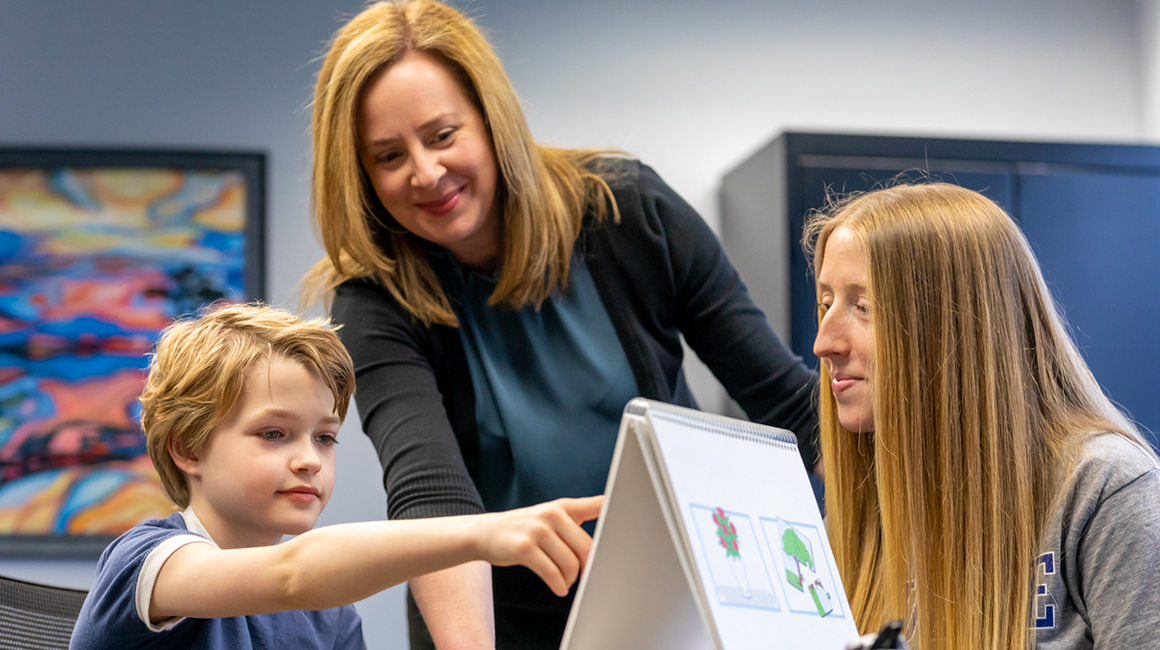
State-of-the-art equipment and facilities providing real-world experience assessing
and treating speech, language, and hearing problems.
A large and diverse network of externships with dedicated clinical instructors who
teach in real-life settings.
Faculty members committed to teaching and research, bringing students the best academic
and clinical education.
A rich student life with opportunities for fun, athletics, cultural events, networking,
volunteerism, international travel and more.
Program Information
Duquesne University Speech-Language Pathology program is the nation's first five-year,
accelerated program that guarantees students a bachelor's and master's degree upon
successful completion
5 years (3 years pre-professional phase and 2 years professional phase)
Required Credit Hours
Required Credits 165 (94 pre-professional phase and 71 professional phase)
Modality
In-Person
Explore Speech-Language Pathology at Duquesne: Virtual Information Session
Join us virtually on October 21 to learn more about our nationally-ranked Speech-Language
Pathology program! Discover what makes our program unique, explore the student experience
and curriculum, and learn how Duquesne can prepare you for a rewarding career in the
field of speech-language pathology. You’ll also have the opportunity to connect with
us and get your questions answered.
1st and top-ranked five-year accelerated Speech-Language Pathology (SLP) Program that
guarantees students a bachelor's degree and master's degree upon completion.
SLP Program Ranked Among Nation's Best in 2025
U.S. News & World Report rankings recognition reflects the program's academic excellence,
expert faculty, and strong student outcomes.
Fifteen years of 100% pass rates on the Praxis exam within six months of graduation.
Our graduates respond to employment surveys reporting that they accepted their first
position within 1-6 months of graduation.
Exceptional clinical preparation
Six semesters of clinical experience for every student. Three semesters of learning
through our on-campus, faculty-led, specialty clinics and three semesters of top notch
externship placements within the Pittsburgh region and potential to study elsewhere
the final semester of the program.
Mixing Music, Science and Sign Language, She Helps Others Communicate
Whoever said art and science don’t mix hasn’t met Brooke Yurick. A passion for helping
others drives the recent alumna. It also explains why she found Duquesne so attractive.
Develop foundations of speech-language pathology practice
Identify and prevent disorders and differences - Identify and prevent speech, language, and swallowing disorders and differences
Conduct and interpret evaluations - Conduct and interpret evaluations of speech, language and swallowing disorders
and differences
Provide Intervention - Provide intervention to minimize the effects of changes in the speech, language,
and swallowing mechanisms
Integrate and apply knowledge and skills - Integrate and apply general knowledge and skills applicable to professional applicable
to professional practice
The Pre-Professional Phase (six semesters) includes University undergraduate core
requirements plus coursework selected to provide a liberal arts education, a basis
in the sciences, and critical thinking skills to prepare students for the Professional
Phase.
Professional Phase (Years 4-5)
Year 4 students are in the 1st Year Professional Phase of the program. Throughout
this phase, students will see 2-3 clients per week on-campus at the Duquesne Speech-Language-Hearing
Clinic.
Beginning with the Fall semester of the 5th year, students are assigned externship
placements off campus. Fall and Spring placements are within the Pittsburgh region.
Summer semester of the 5th year, students have the opportunity to select placements
anywhere in the country.
Course Requirements
Fall of 1st Pre-Professional Year - 17 Credits
SLP 101 - Intro to Comm Sciences & Disorders - 3 cr.
SLP 558 - Intercultural and Global Issues in SLP - 2 cr.
SLP 559 - Business Practices in SLP - 2 cr.
SLP 575 - Capstone Evidence Based Practice - 1/2 cr.
SLP 720 - Thesis III - optional - 1 cr.
Students progress through the program without the need to reapply to the graduate
phase or take GREs. Students earn a B.S. in Health Sciences after the Spring semester
of the 4th year of the program and a M.S. in Speech-Language Pathology at the end
of the 5th year of the program.
A 3.0 cumulative QPA at Duquesne University and a “C” or better in all courses
Documentation of current Basic Life Support
Documentation of completion of health requirements and other pre-clinical requirements
(including: state and federal background checks, and Basic Life Support)
Departmental approval
Important Note:The material contained herein is subject to change from time to time and this publication
cannot be considered an agreement or contract between individual students and the
School. The Rangos School of Health Sciences reserves the right to alter or amend
the terms, conditions, and requirements herein, and to eliminate programs or courses
as necessary. Once enrolled, students should consult on a regular basis with their
Student Success Coach and/or Faculty Advisor for specific information regarding academic
policies pertaining to their respective program
Completing an optional Master’s Thesis will increase the overall credit load by 1
credit (74 total). Thesis students enroll in three 1-credit Thesis courses (SLP 700,
710, and 720) and enroll in 1 less credit for two courses, SLP 575 and either SLP
543 or 544.
Students also have the option of completing a thesis as part of the Professional Phase.
Student Outcome Data
Program Completion Rates
Graduation Year
Completed Program Within Expected Time Frame
Completed Program Later Than Expected Time Frame
Not Completing
% Completed Program Within Expected Time Frame
2023
27
0
0
100%
2024
31
0
0
100%
2025
32
0
0
100%
3-Year Average
0
0
100%
Praxis SLP Pass Rates
Graduation Year
# Of Students Taking Exam
# Of Students Failed Exam
Pass Rate (%)
2023
27
0
100
2024
29
0
100
2025
32
0
100
3-Year Average
0
100
Fostering Relationships
I am grateful for the opportunity to give back to the Duquesne Speech-Language
Pathology program by mentoring students. One of the biggest perks about working in
the Pittsburgh area is the chance to help train students from my alma mater and assist
in preparing them for the start of their careers as SLPs in the very near future!
The 2026-2031 Strategic Plan for the Department of Speech-Language Pathology in the
John G. Rangos, Sr. School of Health Sciences at Duquesne University
Mission
The mission of the Duquesne University Department of Speech-Language Pathology is
to prepare value-oriented professionals who excel in providing evidence-based, person-
and family centered care through the seamless integration of clinical and academic
education, excellence in scholarship, and meaningful engagement with the community,
in alignment with the mission of Duquesne University and the Spiritan charism.
Vision
To be a national model for integrative and mission-driven speech-language pathology
education, where innovation, research, person-centered care, exceptional clinical
education, and community engagement come together to prepare compassionate, reflective
professionals who lead and empower individuals across the lifespan to communicate,
connect, and thrive.
SLP Goal 1: Cultivate Student-Centered Excellence
DU Goal: Duquesne will identify bold pathways to offer students the knowledge and
skills they will need for productive and fulfilling lives and careers in the decades
ahead.
Shared Theme: Preparing students for fulfilling lives and careers.
Objectives:
Integrate classroom, clinical, and research experiences through individualized mentorship.
Incorporate simulation, VR, and educational technology to enhance teaching and clinical
practice.
Expand student participation in scholarly and community-engaged research.
Embed content and experiences focused on person- and family-centered practice, social
determinants of health, advocacy, and leadership in classroom, clinical, and engagement
activities.
Maximize the functionality and innovation of learning spaces in the new Health Sciences
Building.
Goal 2: Deepen Community Engagement and Impact
DU Goal: Duquesne will become the region’s flagship institution for community engagement
through mutually beneficial partnerships that advance the city, the region and the
world.
Shared Theme: Advancing the mission of the department in the region and global community
through community partnerships.
Objectives:
Expand continuing education initiatives.
Develop and sustain partnerships with local, regional, and global organizations.
Support study abroad and global health initiatives.
Goal 3: Advance Interprofessional and Alumni Collaboration
DU Goal: 3. Duquesne’s academic programs will transcend traditional boundaries,
positioning it as a leader in interdisciplinary and interprofessional programs.
Shared Theme: Surpassing traditional academic boundaries.
Objectives:
Advance innovative and interprofessional experiential learning initiatives.
Strengthen RSHS’s role as a community-engaged health sciences hub by aligning academic,
clinical, and research initiatives and experiential learning with the opportunities
of the new Health Sciences Building, fostering thoughtful engagement with key University
Centers and Institutes, and surrounding communities.
Strengthen alumni mentorship and deepen alumni, faculty, staff, and student relationships.
Goal 4: Foster a Thriving, Inclusive, and Innovative Department Culture
DU Goal: 4. Duquesne will create a vibrant campus community that fosters the achievements
of its talented students, faculty and staff.
Shared Theme: Creating a vibrant and supportive work environment.
Objectives:
Promote a culture of belonging, respect, and wellness among faculty, staff, and students.
Strengthen departmental identity and visibility through shared celebrations, internal
spotlights, social media, and marketing, including the recognition of faculty excellence
in teaching, service and scholarship.
Encourage mentorship and development across all roles.
Goal 5: Ensure Program Sustainability and Innovation
DU Goal: 1. Duquesne will encourage an entrepreneurial spirit that will allow it
to creatively steward University assets, adapt to changing environments and enhance
its financial vitality to fulfill its mission for a new era.
Shared Theme: Encouraging entrepreneurial stewardship and creative adaptation.
Objectives:
Leverage new health science building for increased visibility and fundraising opportunities.
Expand marketing and outreach strategies to elevate program visibility and reputation.
Build relationships with donors and alumni to support student scholarships and initiatives.
Partner with the Dean’s Office and University leadership to provide data-driven insight
and recommendations that support long-term program sustainability, adaptability, and
growth.
The master's degree (M.S.) education program in speech-language pathology at Duquesne
University (residential) is accredited by the Council on Academic Accreditation in Audiology and Speech-Language Pathology (CAA) of the American Speech-Language-Hearing Association, 2200 Research Boulevard, #310,
Rockville, Maryland, 20850, (800) 498-2071 or (301) 296-5700. This program is accredited through July 31, 2031.
Any concerns specific to the program's accreditation status should first be addressed
to the program and Duquesne University and then to the CAA. File a complaint against program.