

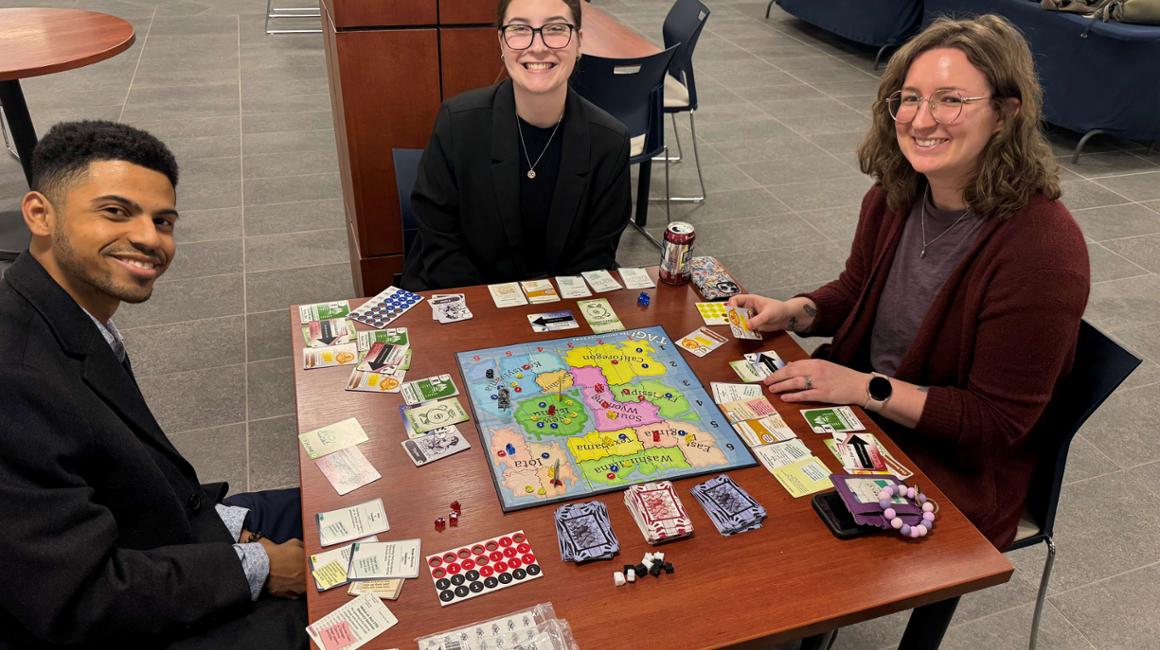
Professor Richard Heppner has taught the complex subject of Civil Procedure at the Thomas R. Kline School of Law of Duquesne University for nine years. While teaching students how a lawsuit travels through federal and state legal systems, he thought there must be a more entertaining way to learn about concepts like jurisdiction and venue. Heppner conjured the idea of a Civil Procedure board game and developed his recently released TAG! The Jurisdiction Game, a fun way to learn the law.
“I’d been working on this game for a few years now. I started working with students on it in 2022. I ran a Game Design Workshop with research assistants from the law school: Rachel Barr, L’24; Olivia Donia, L’24; Riley Frank, L’24; Joshua Miller, L’24; and Victoria Thorp, L’24. We met weekly for the first year to design, playtest, and prototype the game. The next year we revised it and started using it with current 1Ls in my Civ Pro classes,” Heppner said.
He has now used the game to teach federal jurisdiction in his Civil Procedure classes for the past three years. But the game is not just for aspiring lawyers. The game website asks, “Can you get jurisdiction to sue your friends in federal court?” and presents the game as a way for law students and lawyers to review Civil Procedure and for everyone else to learn how tricky the law can be.
The development of the game was partly funded by Duquesne University’s John G. Rangos Sr. Prizes for Students and Faculty. In addition to winning that honor, TAG! The Jurisdiction Game won the 2025 International Serious Play silver award. Heppner has also presented the game at national conferences and continues to use it in his classes.
“Students really enjoy the game, and they tell me that it really does help them with remembering the rules of federal jurisdiction. The most common reaction is kind of surprise that it’s so fun, since it’s just Civ Pro,” Heppner said.
This month, the game became available to the public and more details are available on its website.
“To play the game, it does help to know the rules of federal jurisdiction, so it works great for law students and lawyers. But I really think it is a lot of fun for everyone. I have played it with non-lawyer friends and family, and we all have fun, while also learning about the law together,” Heppner said.
News Information