

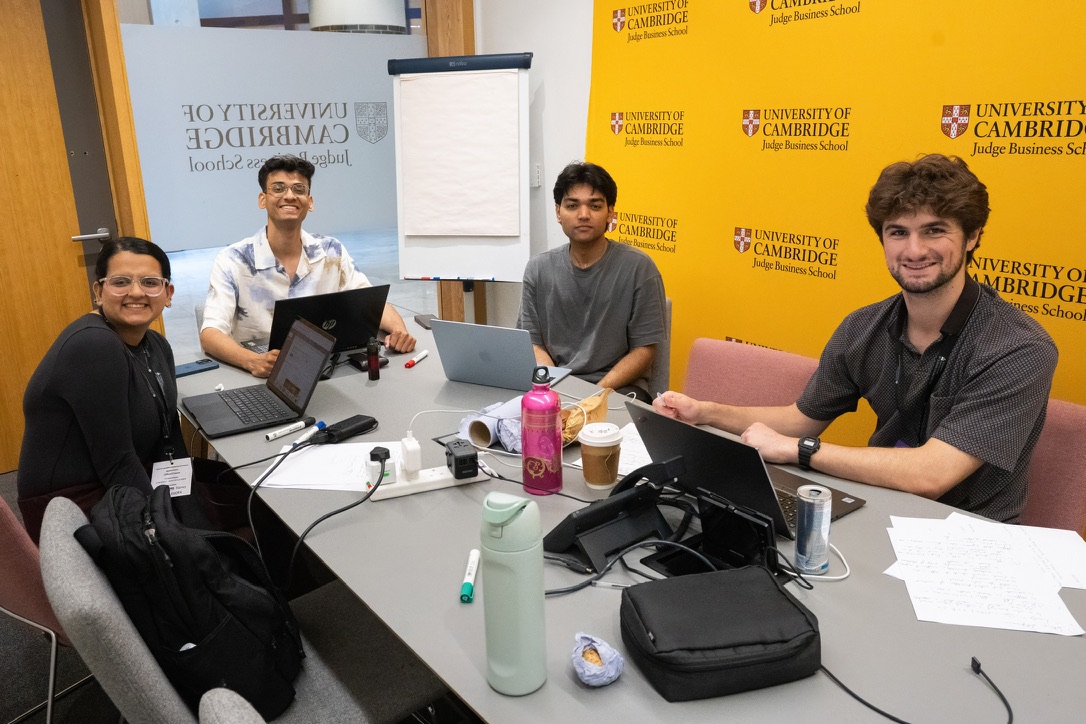
Two Thomas R. Kline School of Law of Duquesne University students recently were selected to participate in the prestigious University of Cambridge’s “Hack the Law” event. Preet Patel, 3L, and Joseph Wyche, 2L, were selected to travel to England to be part of Cambridge’s AI & Law competition, where they won a significant award.
The duo were encouraged to apply for “Hack the Law” by Professor Wesley Oliver, Duquesne Law and Computing Program Director. Patel and Wyche had taken Oliver's Coding for Lawyers class, where they both demonstrated great creativity and a passion for using technology to improve the legal system.
“I had been to Stanford’s CodeX for conference a few years ago. As luck would have it, I googled their annual hackathon and I saw the deadline coming up in a week, so I wrote to Joe and Preet to tell them about it,” Oliver said.
Patel and Wyche were excited to learn about the opportunity. “He flagged the competition and encouraged us to apply. We are thankful to Professor Oliver for putting it in front of us and for teaching us skills we would use during the hackathon,” she said.
They quickly got to work applying, preparing and pitching an AI issue they were working on in. Their application was accepted and they were chosen to attend the “Hack the Law” competition that included attendees from 24 countries. High profile companies sponsored the event, including law’s Bar Standards Board and Luminance and technology’s Google Cloud, Anthropic, and Nvidia.
Patel and Wyche crossed the pond arriving at Cambridge just in time for the Friday evening opening ceremony on June 26, when the whirlwind weekend of brainstorming and competition began. Challenges were released that same evening at the Cambridge Judge Business School.
“That meant the building of our project started that night. The hacking ran from Friday night to Saturday evening; we submitted that night at 9:15 pm, and judging was on Sunday morning,” Patel said.
Before the evening ceremony, Patel and Wyche paired up with two data science students, Priyanshu Gurjar and Aman Raj, from the University of Bristol. The foursome quickly acclimated themselves with each other and went to work on their project.
“The weekend was about learning to combine both the legal and tech elements: we'd speak about what actually gets an attorney in trouble with a court and then figure out how to turn that into something a computer could check. In law school, you learn to argue for a position; in a hackathon, you learn to build one. Watching those two worlds click together was the best part,” Patel said.
The team built a project named Citrus. “Think of it as a nutrition label for the citations in an AI-drafted legal document. When lawyers use AI to help draft a brief, the AI sometimes invents cases that don't exist or cites real cases for things they never actually said. U.S. and UK courts have now dealt with more than a thousand instances of this. Citrus reads a legal document and checks every citation: does the case exist, is the quote really in the opinion, and does the case support the argument? Most tools ask another AI, is this citation good?’ and that answer isn't stable or trustworthy. We want Citrus to break verification into small, checkable questions and answer them with reproducible measurements that a lawyer can audit,” Patel said.
The team finished the competition by earning a second-place finish in the Perplexity tool optimization category.
“As we continue to grow this, we treated the judges' hardest objection, ‘aren't you just using an AI to check an AI?’ as the centerpiece of the pitch rather than something to dodge. We want to show how we'd shrink the AI's role, do the work with stable, reproducible methods, and prove the whole thing empirically. In law, credibility comes from showing your work. We don't want AI tokens to do all the work but rather play an equal role to everything else effectively,” said Patel.
She and Wyche pressed forward and applied for SPARK, a four-week startup incubator at King’s College through their fast-track, where they pitched their idea to venture capitalists. Their goal was to take Citrus from a hackathon prototype toward a real product.
“For two law students in Pittsburgh, it's a little surreal that a project we helped build was being considered by a Cambridge incubator. Law school teaches you to spot risk; this was a chance to build something that reduces it,” said Patel.
While they were not chosen for the Cambridge incubator, Patel and Wyche are going to continue to work toward designing a prototype of a tool that identifies hallucinations before they find their way into court filings, continuing to build a legal future programmed for excellence.
“This was the ultimate goal of the program: to build useful things for the law and get them out there,” said Oliver.
News Information