

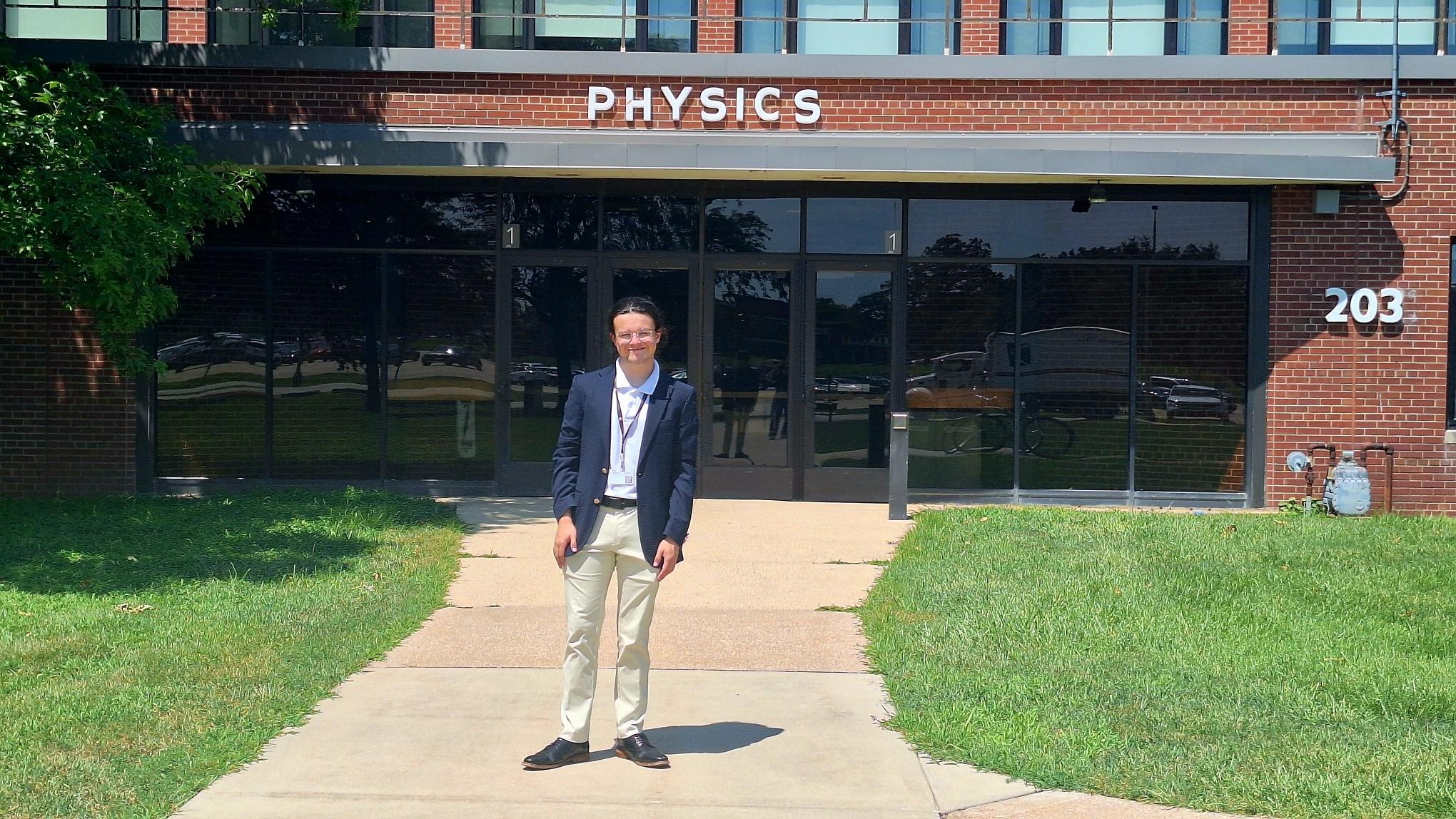
A passion for understanding the universe has taken this junior from undergraduate research at Duquesne to Argonne National Laboratory, Jefferson Lab and a national leadership role in nuclear physics education.
For Cooper Bell, a junior physics major at Duquesne University, curiosity has always come with a determination to find answers.
Growing up in Moon Township, Pennsylvania, Cooper was drawn to physics by a desire to understand how things work. He was particularly fascinated by nuclear and particle physics, a field that explores some of the most fundamental and mysterious components of the universe.
"I was always stubborn about explanations. I looked for the way things work, which led me into developing a passion and interest in physics," Cooper said.
That curiosity quickly became hands-on experience. During his freshman year, Cooper attended an introductory physics lab where Dr. Fatiha Benmokhtar, associate professor of physics, presented her research. Intrigued by the work, he approached her about getting involved.
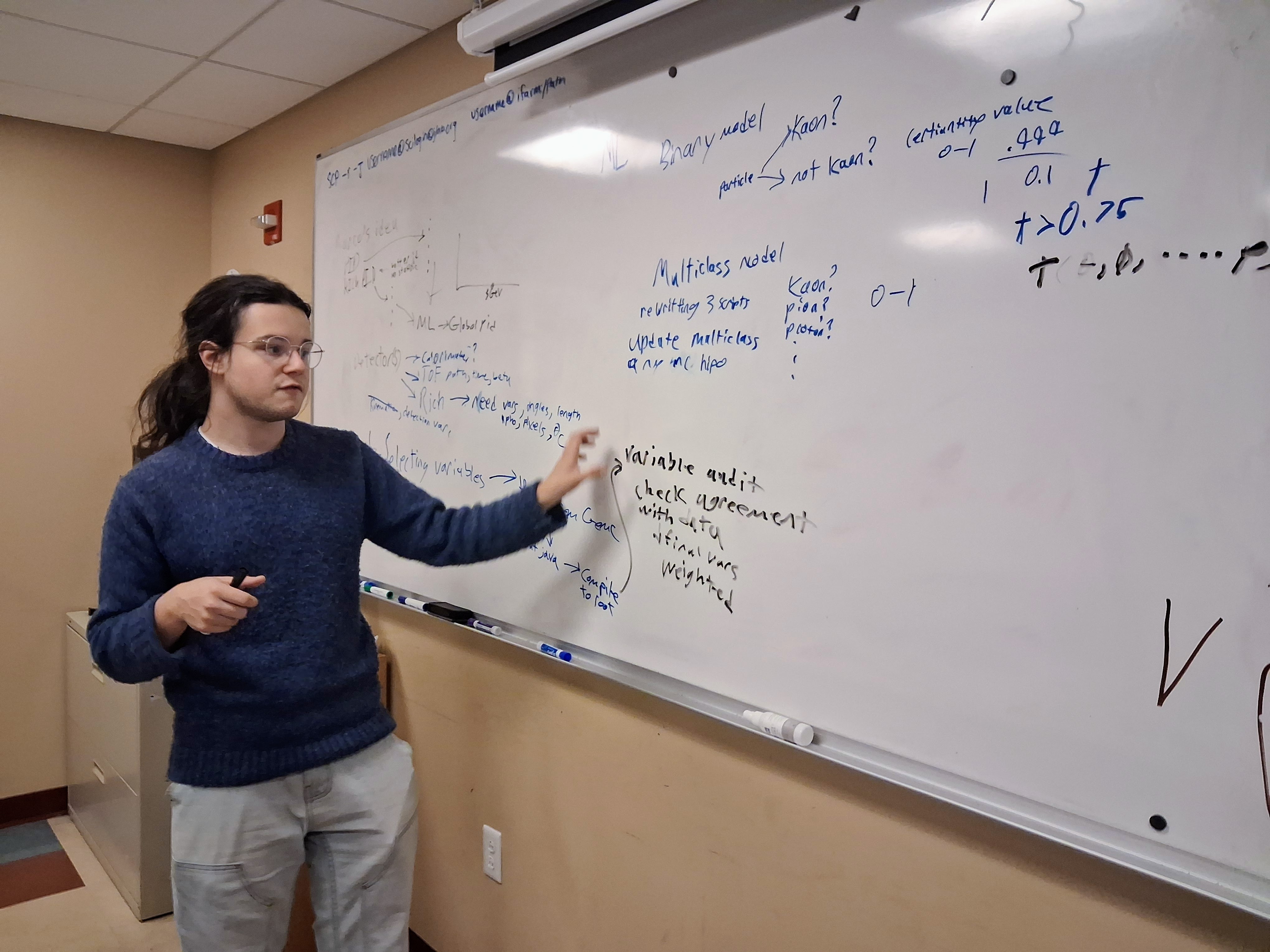
By his second semester, Cooper was learning the fundamentals of data analysis and auditing Dr. Benmokhtar's particle physics course. That summer, he joined Duquesne's Undergraduate Research Program (URP), gaining hands-on experience studying proton scattering with polarized electron beams.
What began as an early introduction to research soon developed into a defining part of his undergraduate experience.
Empowering discovery through research
Cooper's research focuses on Semi-Inclusive Deep Inelastic Scattering (SIDIS) experiments conducted at the CLAS12 detector at Jefferson Lab. By scattering high-energy electrons off protons and analyzing the resulting particles, researchers can investigate the proton's internal structure, including how the spins of its constituent quarks contribute to its overall spin.
Cooper has focused specifically on kaons, particles that offer insight into the proton's strange quark content. However, his work uncovered a significant challenge: existing particle identification methods did not provide enough reliable data to advance the study.
Finding a solution required Cooper to take his research beyond the university.
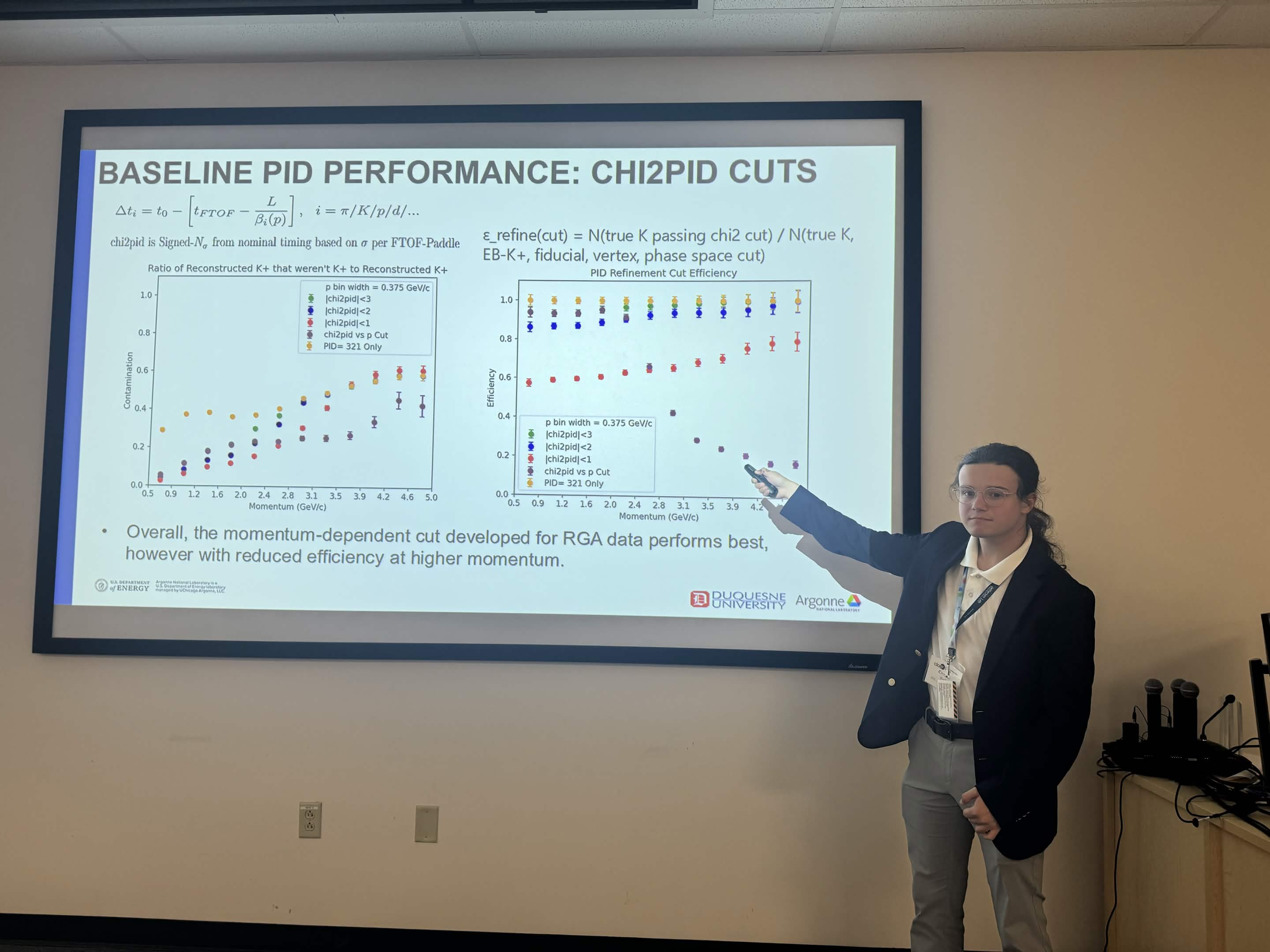
He traveled to Argonne National Laboratory in Illinois, where he completed a competitive internship working to develop a machine learning-based particle identification system. Selected as one of only 250 students nationally, Cooper spent 10 weeks developing a functional machine learning model that uses Time of Flight detector data to distinguish kaons from pions, another type of particle that can contaminate experimental results.
The experience introduced him to machine learning while challenging him to apply his physics background in a rigorous national laboratory environment.
"Outside of the research, it was awe inspiring to be in a lab with so much history," Cooper said. "The research environment was fast paced and rigorous, although I was more than prepared to meet the challenge of my project thanks to the background I built at Duquesne."
His model identified kaons more efficiently and with less contamination than previous baseline methods, offering a potential new approach to particle identification.
For Cooper, the internship demonstrated how the foundation built through undergraduate research could prepare him to contribute to complex scientific challenges.
Learning together through mentorship and collaboration
Behind Cooper's growing research experience has been a consistent source of guidance: his relationship with Dr. Benmokhtar.
Since his freshman year, she has helped him develop his research skills, identify opportunities aligned with his interests and connect with scientists and institutions beyond Duquesne, including Jefferson Lab, Argonne National Laboratory and the National Institute for Nuclear Physics (INFN) in Italy.
"Dr. Benmokhtar has provided me with countless strong opportunities. I'd even go as far to say she shaped who I am as a researcher."
That mentorship has extended into a collaborative research environment where students contribute their individual strengths toward shared scientific goals.
While developing his machine learning model at Argonne, Cooper continued working with his Duquesne research group. The project required extensive simulations to train the model, prompting him to collaborate with fellow students Nathan Carpenter and Max Bucker to help establish the computational resources needed for the work. Their efforts contributed to the development of the group's on-campus supercomputer.
"This type of collaboration is very common within our Duquesne group, everyone, regardless of where they are, is always working in some way to achieve a larger goal," Cooper said.
The experience reflects the value of learning together: faculty mentorship, student collaboration and shared problem-solving can move research forward while helping students develop into independent scientists.
Taking research to the next level
Cooper's work has continued to evolve since his experience at Argonne. This semester, he secured a position through the U.S. Department of Energy's Science Undergraduate Laboratory Internships (SULI) program, allowing him to continue research with Jefferson Lab remotely while remaining at Duquesne and attending classes.
The opportunity is particularly meaningful because remote participation is not typically available through the program. The arrangement was made possible through the strong standing of Duquesne's research group and the mentorship provided by Dr. Benmokhtar.
His current work focuses on detector alignment. Over time, optical components within the Ring Imaging Cherenkov (RICH) detector can become misaligned, limiting the range of usable data. Cooper is working on corrections that restore the detector's alignment and maximize the statistics available for analysis.
This work will lay the groundwork for the next phase of the research: developing a Global Particle ID system that combines RICH and Time of Flight detector data with machine learning to improve particle identification.
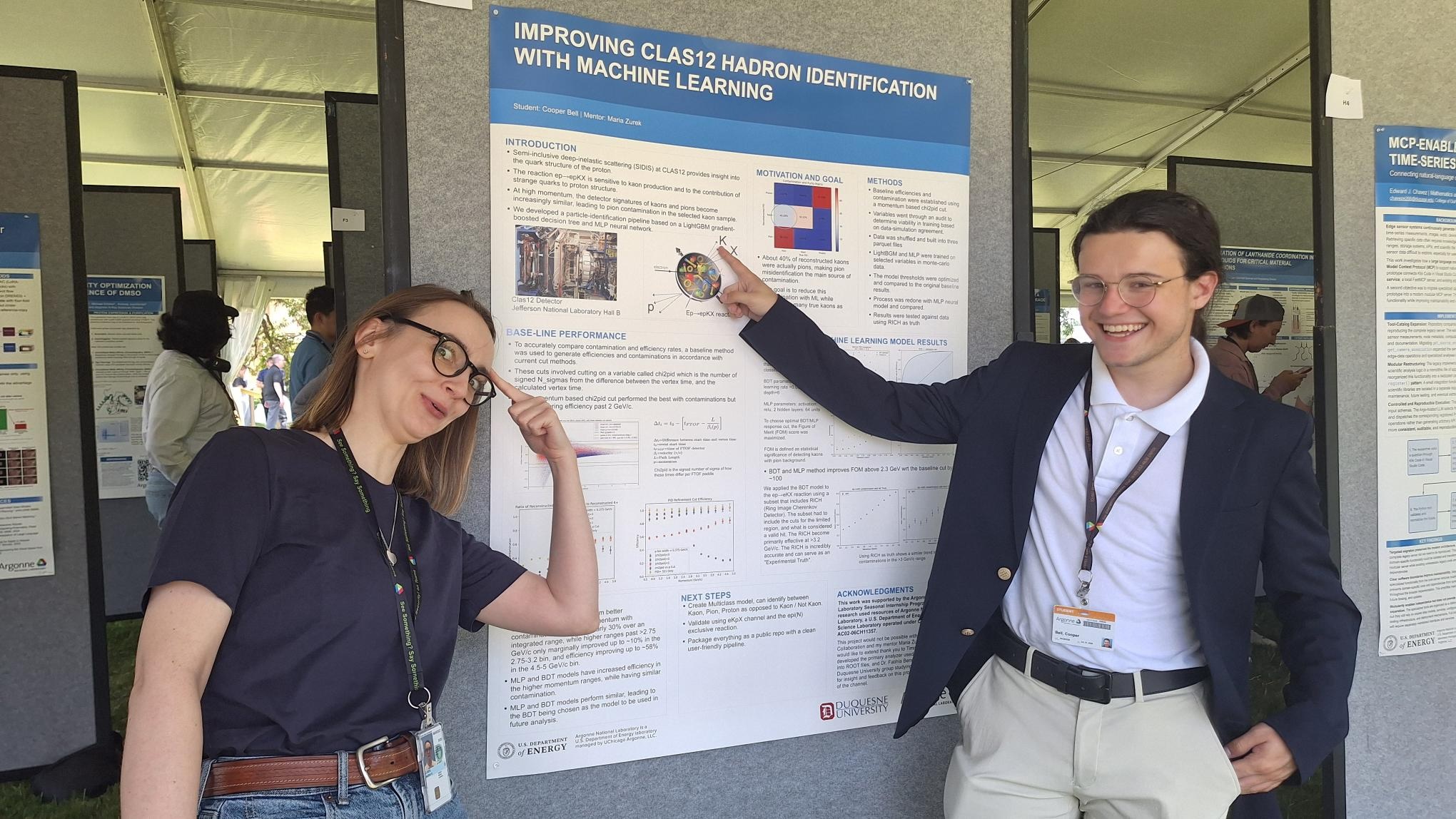
Beyond the technical knowledge, Cooper's experiences have strengthened his programming, data analysis, computational and public speaking skills. He has presented three research posters and delivered oral presentations at Jefferson Lab international collaboration meetings and the American Physical Society/Division of Nuclear Physics meeting, as well as shared his work at Duquesne's Undergraduate Research Program and Undergraduate Research and Scholarship Symposium.
He has also learned that scientific discovery rarely follows a straight path.
"Physics in practice is not very clean compared to theory," Cooper said. "There have been many times where I thought analysis would be simple, and then it's taken months. The spontaneous challenge was not something I initially considered with the work. At the same time, these same challenges are what makes the work exciting!"
Creating opportunities for the next generation of physicists
Cooper's impact extends beyond his own research. He serves as the undergraduate nuclear physics representative on the American Physical Society's (APS) Division of Nuclear Physics Education Committee, where he works with committee members to identify ways to strengthen undergraduate education and encourage greater involvement in nuclear physics.
In this role, Cooper brings the undergraduate perspective to discussions about engaging students in the field, supporting emerging researchers and helping young scientists navigate opportunities in a time of limited funding.
He has also contributed ideas for undergraduate outreach resources and ways to help students become more competitive for research opportunities. His involvement includes providing feedback on the Conference Experience for Undergraduates, a program directed by Dr. Benmokhtar that introduces students to nuclear physics research and the scientific community.
For Cooper, the opportunity to advocate for other students is personal.
"If it had not been for the encouragement and guidance I've received since attending Duquesne University, I may not have ever gone into physics."
"That is why to me being in a position where I can represent and advocate for younger researchers is so important, because it opens the doors for those undergraduates, or soon to be undergraduates, to grow their passion for physics into valuable career and academic experience."
As a Physics student ambassador at Duquesne, Cooper also enjoys introducing prospective students to the possibilities of studying physics. When he first visited Duquesne, he was initially considering engineering because he wasn't familiar with the range of careers and opportunities available to physicists.
Now, he works to help other students see those possibilities and recognize that they can succeed in the field.
His advice to students interested in research is straightforward: take the first step.
"I would tell a first-year student to just go for it. Research is such a powerful experience that teaches you not only great scientific skills, but many other transferable skills," Cooper said. "You must go in with the confidence that you can do it, and don't worry about not knowing enough, because the only way you can learn is to start learning!"
Looking toward the next discovery
From his first research experience as a freshman to his work with national laboratories, international collaborations, and professional scientific organizations, Cooper's undergraduate journey demonstrates how early opportunities, faculty mentorship and collaboration can expand what students believe is possible.
As he looks ahead, he hopes to continue investigating particle physics at medium and high energies, exploring the fundamental building blocks of matter and questions surrounding the spin structure of the proton.
His proudest accomplishment so far has been presenting his completed research project to his Duquesne research group. The project brought together data analysis, software development, detector studies, simulations and theoretical concepts.
For Cooper, completing the work represented more than a finished research project. It demonstrated how much he had learned and how far he had grown since first walking into an introductory physics lab.
At Duquesne's School of Science and Engineering, students are empowered to pursue ambitious questions, collaborate with faculty and peers, and innovate solutions to complex challenges. Cooper's experience reflects that promise: a horizon-expanding education that begins with opportunity, prepares students for what comes next and equips them to create opportunities for others.
News Information