

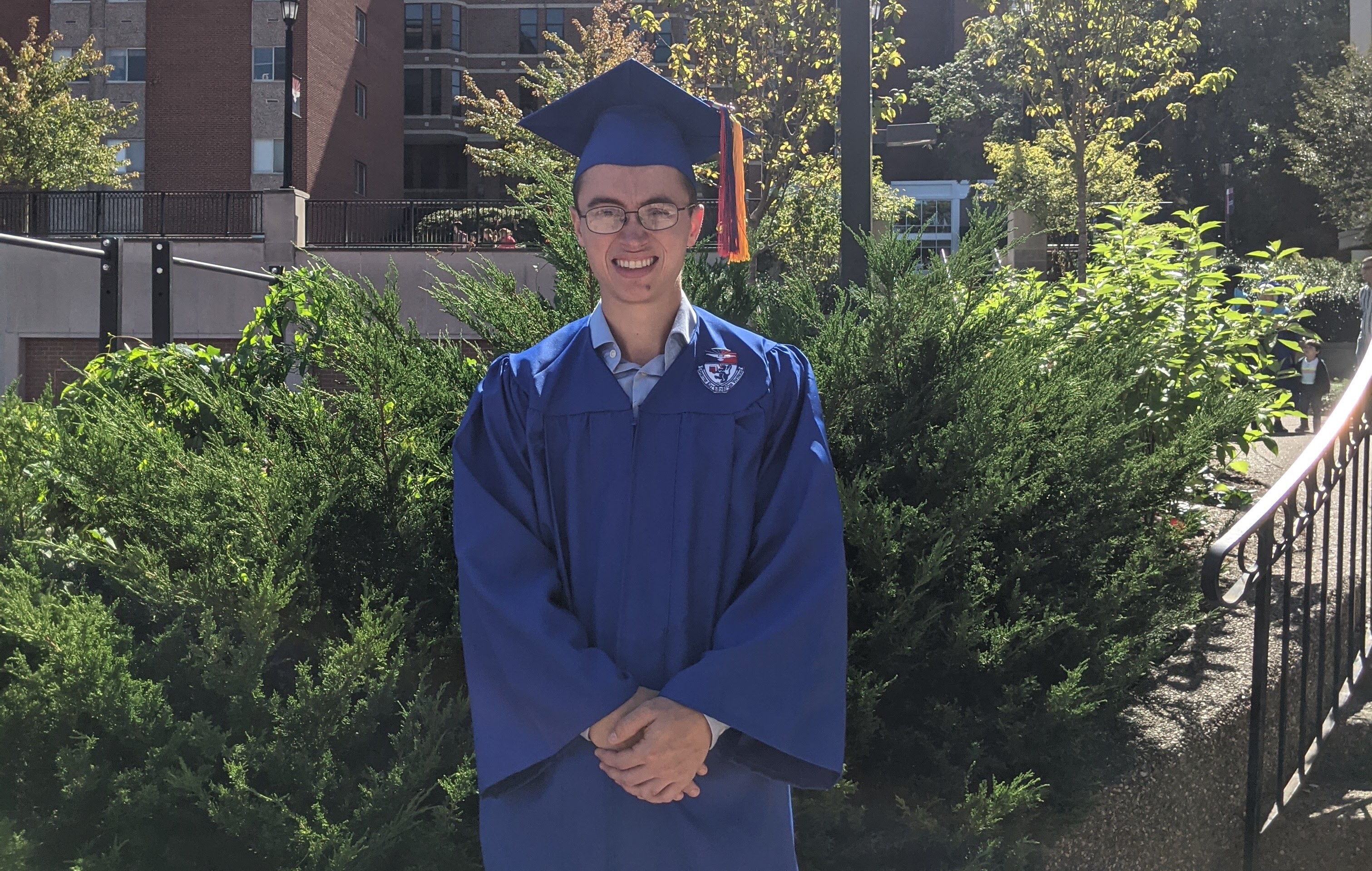
A graduate of Duquesne University’s Physics and Engineering 3+2 program, Jake Kline combined three years of physics coursework and undergraduate research at Duquesne with advanced engineering studies at the University of Pittsburgh.
Today, he puts that interdisciplinary education to work as a Senior Structural Designer at GFT, Inc., helping design buildings across a range of industries. Originally from Northern New Jersey, Jake was already familiar with Pittsburgh through visits to his grandparents. When he toured Duquesne, he connected with the campus community and saw the Physics and Engineering 3+2 program as an opportunity to pursue two complementary fields.
“The rigor of the program combined with the dual degree felt like it would help me stand out in a positive light compared to other engineering candidates when applying for employment.”
A Strong Foundation in Physics and Engineering
Jake graduated from Duquesne in 2018 with a Bachelor of Arts in Physics before continuing at the University of Pittsburgh for the engineering portion of the program. He earned a Bachelor of Science in Civil Engineering in 2020 and a Master of Science in Structural Engineering in 2021 as Pitt’s inaugural John F. Oyler Scholar.
His interest in structural engineering grew from an early fascination with buildings and an aptitude for mathematics. He recognized that studying physics before engineering would give him an important academic advantage.
“The extra foundation and knowledge based in mathematics and practical physics really put me ahead in terms of critical thinking and problem solving. The engineering path I wanted to take featured statics and mechanics courses and having that foundation was crucial.”
The demanding physics curriculum prepared Jake for the advanced engineering coursework at Pitt, strengthening the analytical skills he would rely on throughout his career.
Research and Faculty Mentorship
At Duquesne, Jake found more than a rigorous academic program. He became part of a close-knit community where faculty members were accessible and students worked together to navigate challenging coursework.
Smaller classes and academic groups helped him build relationships with fellow students, whose collaboration became an important part of learning and preparing for exams. He also credits the enthusiasm and support of his professors with making complex subjects engaging.
Jake gives particular credit to Dr. Frittelli, who serves as the head of the Physics program, his academic advisor and one of his professors.
“Dr. Frittelli was essential to my growth as a student at Duquesne,” he says.
He also points to his undergraduate research experience with Dr. Corcovilos in the Atomic and Optical Physics Lab as a defining part of his education. Beginning the summer after his freshman year, Jake contributed to a project to assemble a wavemeter used to measure the frequency and wavelength of a helium-neon laser.
His work included assembling surface-mount circuit boards, building a laboratory computer and using SolidWorks to develop 3D-printing designs. The experience introduced him to a professional laboratory environment and helped him develop technical skills beyond the classroom.
Seeing how research connected to the physics concepts he was studying also deepened his interest in the field.
“Seeing the research applications while concurrently taking relevant courses was interesting and increased my engagement in both the research and my classes.”
That early experience also helped open doors beyond Duquesne. At Pitt, Jake secured another research opportunity in the ISMART Lab with Dr. Alavi, drawing on the 3D-printing experience he had gained at Duquesne.
Collaborating Across Two Universities
The 3+2 program gave Jake the opportunity to learn within two university communities, each offering different resources and experiences. While adjusting to a larger campus environment at Pitt took some time, he valued the support and connections he had built at both institutions.
He relied on recommendations from professors at Duquesne and Pitt when pursuing research, internships and employment opportunities. He also took advantage of Pitt’s career resources as he prepared to enter the workforce.
Looking back, Jake sees collaboration as one of the most valuable parts of his Duquesne experience. Working alongside classmates and building relationships with faculty helped him feel supported as he took on challenging material and pursued opportunities beyond the classroom.
That sense of community reflects the School of Science and Engineering’s promise to empower, collaborate and innovate. Students are empowered to develop their skills and explore new opportunities, collaborate with faculty and peers, and apply what they learn to real-world challenges.
Applying Physics to a Career in Structural Engineering
Today, Jake is a Senior Structural Designer at GFT, Inc., working in the company’s Buildings & Places sector. His responsibilities include preparing and drafting structural drawings and specifications for building projects across multiple industries.
He credits his physics background with giving him the foundation to become a strong engineer, particularly through the problem-solving and critical-thinking skills he developed at Duquesne. The combination of demanding coursework and research also taught him how to organize his time and manage complex responsibilities.
Jake believes the 3+2 program helped distinguish him as a candidate while preparing him for the technical demands of his profession. His research experiences at both universities strengthened his résumé and helped him pursue opportunities in engineering.
Advice for Future Physics and Engineering Students
For students considering the Physics and Engineering 3+2 program, Jake encourages them to take advantage of the faculty support and hands-on opportunities available at Duquesne.
“Do not be afraid to ask questions and engage with the professors.”
Although he had not regularly attended office hours before college, he made them part of his routine at Duquesne and found the conversations valuable to his academic growth.
He also encourages students to pursue opportunities even when they may feel underqualified.
“I was not sure if I would get that research position with Dr. Corcovilos given my inexperience, but I am glad that I reached out to him regardless,” Jake says.
His experience demonstrates how a strong foundation in physics, meaningful faculty mentorship and a willingness to explore new opportunities can help students turn their interests into a career. Through the Physics and Engineering 3+2 program, students can build the knowledge, relationships and practical experience to take on the challenges of tomorrow’s engineering fields.
News Information