

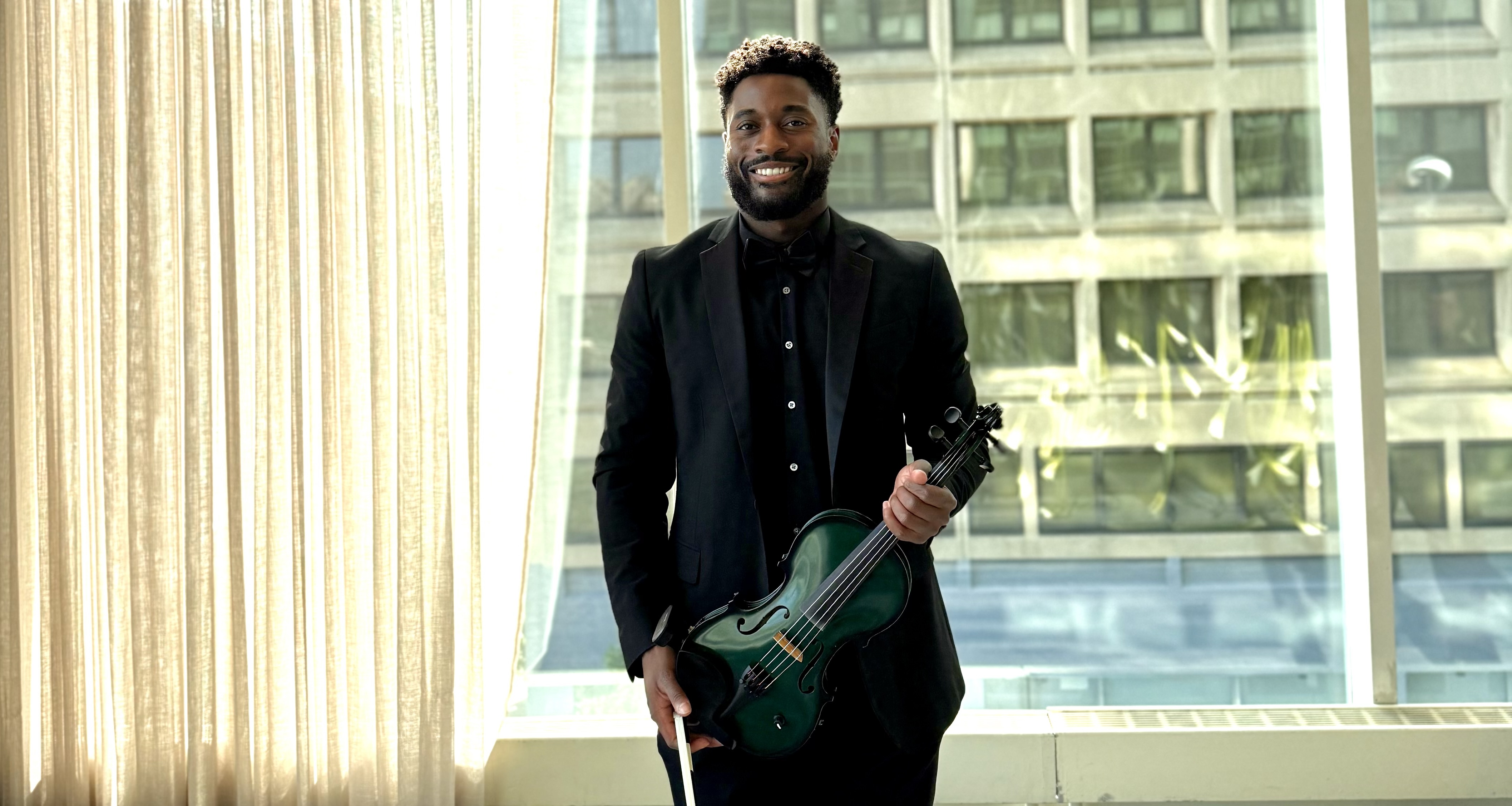
Manny Apea didn’t know where biotechnology would take him. That was the point.
When Manny first enrolled at Duquesne University, the Germantown, Maryland, native was preparing for medical school.
He wanted to strengthen his academic foundation in the sciences, challenge himself through rigorous coursework and demonstrate that he could succeed in an advanced scientific environment.
But the 2023 graduate’s path after Duquesne has taken him in directions he did not initially anticipate.
Today, Manny works in cloud engineering at the University of Rochester, supporting technology and infrastructure used by research groups including the Genomics Research Center and the Center for Integrated Research Computing. Outside of his technology career, he has also built a growing career as an electric violinist and DJ, performing at weddings, private events and other venues.
For Manny, those paths may look different on paper. But the skills he developed through Biotechnology continue to connect them.
“Education should expand the number of possibilities in your life, not reduce them.”
Building a Foundation for What's Next
Manny was initially drawn to Duquesne’s Biotechnology program because it brought together biology, medicine, research and emerging technology.
He appreciated that the program could strengthen his scientific background while exposing him to areas beyond the traditional pre-med path.
Looking back, that breadth has become even more valuable.
Although Manny’s career eventually moved toward technology and cloud engineering, he continues to work alongside scientific and research environments. His biotechnology background gives him a foundation for understanding the work taking place around him while his technical expertise allows him to contribute to the infrastructure that supports it.
“I may not be working at the bench, but I still contribute to the systems and infrastructure that help researchers do their work,” he said.
The analytical thinking, research skills and problem-solving mindset Manny developed at Duquesne continue to influence how he approaches complex challenges.
For prospective Biotechnology students, his experience demonstrates the range of possibilities that can grow from a strong foundation in science.
Learning How to Tackle Complex Problems
One of the most valuable lessons Manny took from Biotechnology was learning how to work through problems without immediately knowing the answer.
As a student, he regularly encountered complex research papers filled with unfamiliar terminology, scientific mechanisms and information he did not understand on the first read.
Instead of being intimidated by the material, he learned how to break it down.
He would research unfamiliar terms, consult scientific resources, read background material and piece together the information until he could understand the research well enough to discuss it.
“That process taught me how to be comfortable not knowing something right away. Instead of getting intimidated by complexity, I learned to slow down, research it, break it apart, and keep digging until it made sense.”
That approach has stayed with him.
Today, Manny uses the same process when troubleshooting cloud infrastructure, reading technical documentation or working through unfamiliar technology systems.
The subject matter may be different, but the mindset is the same: stay curious, research the problem, break it down and keep working until it makes sense.
Finding Connections Between Science and Creativity
Manny’s education also shaped the way he approaches his creative pursuits.
He credits his parents, who immigrated from Ghana, with first putting a violin in his hands and encouraging him to pursue education seriously from a young age.
After first learning violin as a child, he returned to the instrument in his early twenties and began experimenting with the electric violin and contemporary music. What started as a personal passion eventually grew into a professional career.
He now performs R&B, hip-hop, Afrobeats, pop, Latin music and other contemporary music, bringing a modern approach to an instrument he once associated primarily with his childhood.
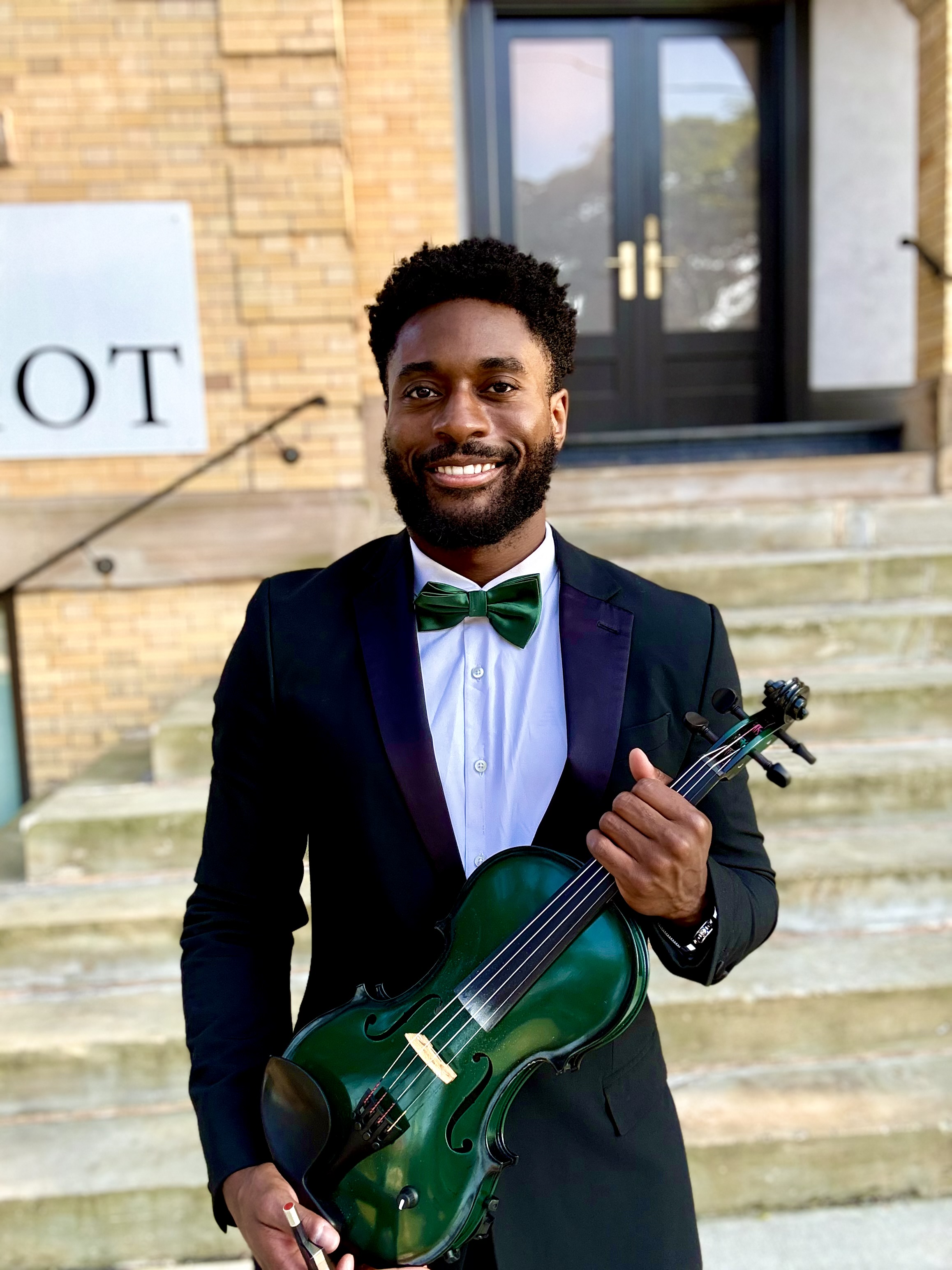
For Manny, science and music share more similarities than people might expect.
In science, researchers develop ideas, test them, learn from the results and adjust. Manny approaches music in much the same way, experimenting with sounds, arrangements, transitions and performance styles.
Both require curiosity, creativity and a willingness to explore an idea before knowing exactly where it will lead.
“I think that is what connects the two for me,” he said. “In both science and music, you have to be comfortable exploring something before you fully understand where it is going.”
From Passion to Possibility
Manny’s music career is another example of how unexpected opportunities can grow when you are willing to put your work into the world.
When he first began posting violin performances online, some videos received only a few hundred views. He continued creating and sharing his work anyway.
Eventually, someone from Long Island discovered one of his videos and reached out about having him perform at a wedding.
That opportunity helped Manny realize that he did not need to have everything figured out before putting himself out there.
Since then, his music career has grown into a business. He has learned about pricing, contracts, sound equipment, marketing, social media, travel logistics and client communication while performing for weddings, private events and corporate events across different states.
One particularly meaningful experience came when he was invited to appear on CBS Pittsburgh’s Talk Pittsburgh to discuss his music career.
Another came through a private performance for a family celebrating their daughter ringing the chemo bell after completing treatment.
“That experience stayed with me because it reminded me that music is not only about entertainment, social media, or being on a stage,” Manny said. “Sometimes you are being invited into one of the most important days of someone’s life.”
His experiences have reinforced the importance of pursuing opportunities even when their eventual impact is not immediately clear.
Empowered to Keep Exploring
Manny’s career today looks different from what he imagined when he arrived at Duquesne.
He works in cloud engineering and wants to continue taking on increasingly complex challenges related to infrastructure, security and research technology. At the same time, he is working to grow his career as a violinist, DJ, producer and creator, with goals of performing at larger stages, festivals and international events.
He is also interested in exploring the intersection of technology and music.
“I do not want to know exactly where the ceiling is,” he said. “I want to keep building until I find out.”
That willingness to keep learning and exploring reflects one of the most important lessons Manny took from his Duquesne experience: your education can prepare you for possibilities you cannot yet see.
His advice to current students is not to feel pressured to have their entire future mapped out.
“You do not need to have your entire life mapped out at 20, 22, or even 30. You just need to keep becoming someone who is prepared when the next opportunity appears.”
For students considering Biotechnology, Manny’s story offers a broader perspective on where a scientific education can lead. The knowledge and skills developed in the program can become a foundation for careers in science, healthcare, technology and beyond.
And sometimes, the path you build after graduation may look completely different from the one you imagined when you started.
That is part of the possibility.
News Information