Juris Doctor - Part-Time Evening Program

Thomas R. Kline School of Law of Duquesne University has offered a part-time evening JD program for working professionals and adults with other commitments and priorities for over a century. In fact, Duquesne Kline School of Law is the only institution in Pittsburgh and the surrounding area of its kind.

Professionals from diverse backgrounds and experiences come to Duquesne Kline Law to pursue a Juris Doctor degree part-time while working full- or part-time. Our evening students earn their part-time J.D. after only four years of study.

Conveniently located within blocks of downtown Pittsburgh, Duquesne Kline Law offers evening courses Monday through Friday, beginning at 6 p.m. Professionals in the part-time program include those working in energy, engineering, finance, taxation, information technology, and numerous other fields. The list of part-time alumni is impressive and includes business owners, law firm partners, judges, corporate counsel, solo practitioners, and many others.

How to Apply

Admission criteria and performance standards are the same in all day and evening law programs. Applications are accepted Sept. 1 - April 1 for priority consideration for all J.D. programs, including part-time. Applications will be accepted from May 1 through July 31 on a space-available basis. 

Program Information

Duquesne University Thomas R. Kline School of Law of Duquesne University is the only Pittsburgh law school offering an evening law program. Professionals from diverse backgrounds and experiences come here to pursue a Juris Doctor degree part-time while working full- or part-time. Our evening students earn their part-time J.D. after only four years of study.

Program Type

Major

Degree

Doctorate

Duration

4-year

Required Credit Hours

87

Modality

In-Person
Hyflex

Flexible Programming

In Fall 2024, we began offering a flexible part-time Evening program for law students.  Our aim is to add flexibility for our part-time evening students during their legal education and to further promote access to legal education. Please note this is not a fully online program. 

  • In the first year, Contracts, Civil Procedure, Torts, and Legal Writing, are each taught once per week on Monday through Thursday evenings respectively. These courses will be taught in a hybrid modality.
    • For these four courses, the first two weeks of classes will be designated as in-person only.
    • Generally, during the remaining 11 weeks of the semester, faculty will then conduct classes in a synchronous modality with students in the classroom and potentially some students on Zoom.  
    • Please note, faculty will have the discretion to move a particular class session to fully on Zoom, or to require in-person attendance, for pedagogical purposes.
    • Students will not be permitted to Zoom every week but will have the option to attend class remotely on Zoom for 5-6 class sessions throughout the 13-week semester. That is approximately half of the remaining class sessions, following the first two weeks of in-person classes.   
    • If a class session is designated as in-person only and a student cannot make class, the student will have to take an absence from class but may be able to review a video of the class, if one is available.
  • All required courses for the evening program will be taught in the hybrid or fully online format as the program is phased in. 
  • Evening electives will be taught in this modality unless excepted for pedagogical reasons by the Academic Dean.  
  • All evening division students will be expected to be available on campus for in-person exams.
  • Qwickly attendance (or a similar tool) will be used to allow faculty to distinguish between in-person and remote students.
  • Faculty may require reasonable notification from a student who wants to Zoom into class, for example, notification at least 24 hours in advance. Where notice is required, faculty will include a course policy for certain emergency situations where Zoom attendance may be necessary for a student.
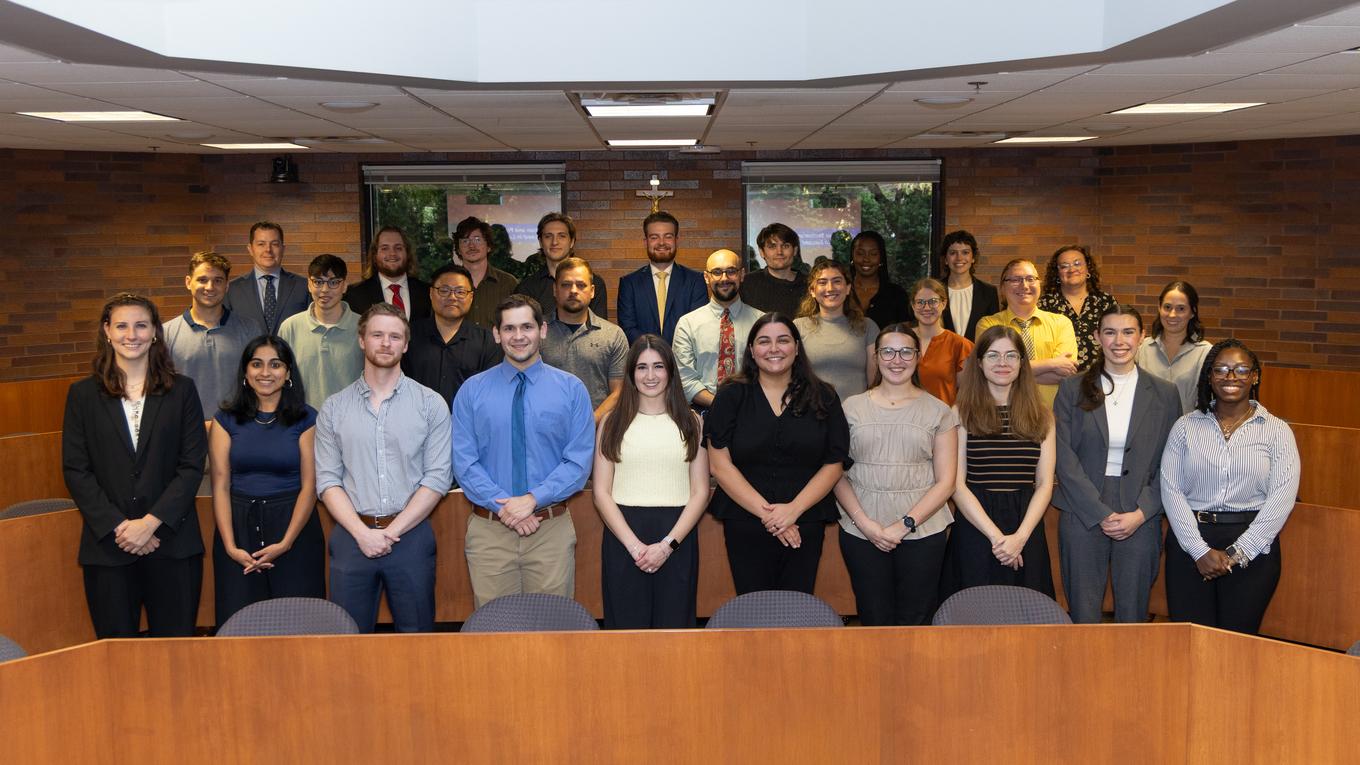
Law students studying

Current semester class schedules

Part-Time Evening Scholarships

All accepted students are automatically considered for merit-based scholarships. Incoming student scholarships are renewed annually, provided the student remains in Academic Good Standing. Duquesne University Thomas R. Kline School of Law of Duquesne University does not award conditional scholarships - that is, financial aid dependent upon a student maintaining a minimum grade point average or class standing, other than that what is ordinarily required to remain in Academic Good Standing.

Merit scholarships specifically for part-time students include the following, a number of which are funded from the proceeds of endowed funds.

  • Catherine Celeste Dillon Memorial Scholarship
  • Randy K. Hareza Endowed Scholarship
  • John J. Hickton Endowed Scholarship
  • Law Alumni Association Endowed Scholarship
  • Edward J. Krug Endowed Scholarship
  • Law Faculty Scholarship for Excellence
  • Law School Scholarship for Excellence
  • H. Murray Lubic, L'26 Endowed Scholarship
  • Morris L. and Helen E. Machen Endowed Scholarship

No separate scholarship applications are required. Read more about scholarships.

Tuition and Financial Aid

Competitive tuition rates and generous financial aid make Duquesne Kline Law affordable. In fact, National Jurist magazine calls Duquesne a "Best Value" law school.

Students work directly with Duquesne University's Office of Financial Aid to apply for federally funded or institutional aid such as Stafford Loans, GradPLUS Loans, and private educational loans. Interested students should submit a FAFSA online at fafsa.ed.gov before May 31. Applicants to Duquesne Kline Law DO NOT have to complete the Duquesne Financial Aid Application. Learn more about applying for aid as a graduate student.

Curriculum

First Year Part-Time Evening Required Courses

Course Credits
Civil Procedure and Drafting I (fall) 3
Civil Procedure II (spring) 2
Contracts I and II (fall and spring) 6
Legal Research & Writing I and II (fall and spring) 5
Torts I and II (fall and spring) 5

Second Year Part-Time Evening Required Courses

Course Credits
Advanced Legal Reasoning (fall - required for bottom 25% following first year) 2
Constitutional Law I and II (fall and spring) 5
Criminal Law (fall) 3
Criminal Procedure: The Police Function (fall or spring) 2 or 3
Property I and II (fall and spring) 6
Business Associations (may be taken in the second or third year (fall or spring) 3

Third Year Part-Time Evening Required Courses

Course Credits
Business Associations (may be taken in the second or third year- fall or spring) 3
Evidence (fall or spring) 3
Professional Responsibility (may be taken in the third or fourth year- fall or spring) 3


Fourth Year Part-Time Evening Required Courses

Course Credits
Core/Applied Competencies I and II (fall and spring) 6
Professional Responsibility (may be taken in the third or fourth year- fall or spring) 3
Sales (fall or spring) 2

Course descriptions may be found on the Law School Registrar's Curriculum page.

Courses shown are required. Students are advised that the graduation requirement for all divisions is 87 credits total.

All matriculating students are required to satisfy an Upper-Level Writing requirement and 6 credits of Experiential Learning.

Because Duquesne periodically reviews and revises its curriculum, course offerings and credit hours are subject to change at any time.

Learning Outcomes

A. Knowledge and understanding of substantive and procedural law

A.1. Fundamentals & Bar Exam: Remember and explain the black-letter law in the core doctrinal areas.

A.2. Legal Policy: Recognize the law's theoretical frameworks and trace their influence and the influence of extra-legal factors (e.g., politics, history, culture, etc.) on the development of substantive doctrine.

A.3. Legal System: Explain and differentiate among key conceptual categories of law and understand the hierarchy of authority.

A.4. Practical Knowledge Development: Integrate information from multiple sources (e.g., opinions, statutes, regulations, rules, scholarly analysis) to identify operative legal rules, principles and concepts.

A.5. Specialty Areas: Remember and explain the black-letter law in the substantive and procedural law on specialized topics.

B. Legal analysis and reasoning, legal research, problem-solving, and written and oral communication in the legal context

B.1. Interviewing, Counseling, and Negotiating: Investigate and analyze facts to achieve a client's objectives or otherwise solve a legal problem and recommend a solution.

B.2. Legal Analysis and Reasoning: Critically read the applicable authority, including identifying the key rules within each authority; synthesize the relevant rules into an analytical framework, identifying which rules the court is most likely to apply, and apply the rules to the relevant facts.

B.3. Legal Research: Create and execute an effective, efficient legal research strategy to conduct legal research with the appropriate use of sources and technology.

B.4. Problem Solving: Develop systems and procedures for effectively working with other people and to ensure that time, effort, and resources are allocated efficiently in a legal practice.

B.5. Written and Oral Communication: Draft legal and non-legal documents in the manner expected of a competent new lawyer and communicate orally in a manner appropriate for the audience and purpose.

C. Exercise of proper professional and ethical responsibilities to clients and the legal system

C.1. Cultural Competence: Work with others of diverse backgrounds and understand the importance of building an inclusive community characterized by interdependence, dignity, equality, compassion, and respect.

C.2. Diligence: Demonstrate a strong work ethic, engage in productive time management, understand the principles of timely project submittal, and be punctual and respectful.

C.3. Leadership: Exemplify servant leadership through ethical conflict resolution and emotionally intelligent engagement in teambuilding, collaboration, and cooperation.

C.4. Pro Bono: Possess knowledge and understanding of the lawyer's professional and civic responsibility to advance the mission of community service.

C.5. Professional Integrity: Uphold a strong sense of honor and conduct affairs with honesty, dignity, and care, while treating others with civility, fairness, and respect.

D. Other professional skills needed for competent and ethical participation as a member of the legal profession

D.1. Judgement: Recognize the importance of relevant non-legal considerations when advising clients regarding available outcomes and avenues, such as moral, emotional, economic, social, and political considerations.

D.2. Respect for Others: Practice in a diverse society and world by engaging competently with persons from a variety of backgrounds and holding a variety of views.

D.3. Reflection and Self-Evaluation: Develop an ability to critically evaluate the performance of self and others when performing legal tasks including recognizing, evaluating, and understanding one's own roles in resolving ethical dilemmas.

D.4. Self-Care: Seek and use resources when necessary to address personal challenges including managing workload and stress; recognize common causes of lawyer misconduct and be aware of sources of support for lawyers.