

Biochemistry
The Bachelor of Science (B.S.) in Biochemistry program at Duquesne University offers a comprehensive exploration of the core principles and applications of biochemistry. chemistry, while investigating the properties and reactions of organic compounds.
Practical experience is a cornerstone of our program. As you progress, you'll have opportunities to collaborate closely with faculty, delving into independent research projects. This isn't just about earning a degree; it's about showcasing your passion and expertise by presenting your findings not only at on campus research symposiums but also on a national stage at prestigious meetings. It's a path filled with discovery, challenges, and endless opportunities to make your mark in the field of biochemistry.
Tailored towards healthcare professions, our program includes a pre-medical track, equipping students for advanced studies or medical school. Whether aspiring to be a physician, dentist, pharmacist, or pursuing other healthcare roles, our curriculum provides a solid foundation for future endeavors.
Program Information
The Bachelor of Science in Biochemistry program involves training in organic, inorganic, and physical chemistry as well as in biology, genetics, and biochemistry. Elective coursework is also available to pursue interests in a variety of advanced topics involving the chemistry of biological systems.
Program Type
Major
Degree
Bachelor's
Academic Department
Chemistry and Biochemistry
Duration
4-year
Required Credit Hours
120
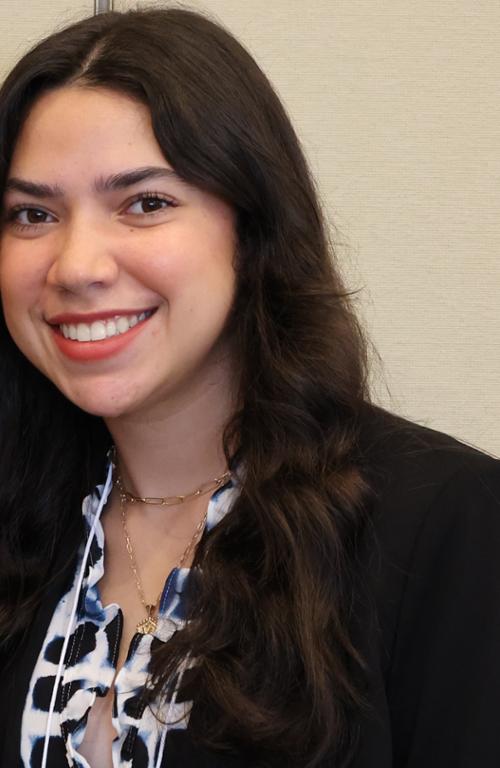
"Coming from Puerto Rico, I thought that I might stand out or not fit in quite
right, but as soon as I got to Duquesne, I felt like I belonged."
Explore our diverse array of clubs and organizations spanning interests in biochemistry
and other STEM programs. With guidance from faculty advisors and staff, you'll have
the opportunity to meet students with similar interests, organize events and make
a positive impact in your community. The Student Experience
Join A Student Organization
Prepared For Anything
Graduate Education
Graduate studies in biochemistry pave the way for specialized research and advanced career opportunities. Pursue a master's or doctoral degree in biochemistry, delving deeper into the intricacies of the field and making significant contributions to scientific knowledge.
After Duquesne
Suggested Course Sequence
To assist students in achieving their academic goals within the B.S. in Biochemistry program, we recommend the following course sequence. It is important to note that BRDG courses can be completed in any order throughout the undergraduate curriculum, allowing for greater flexibility in scheduling.
Undergraduate research is highly encouraged. Our department recognizes the value of research and the significant contributions it can make to the scientific community.
- CHEM 151 Atomic & Molec Principles (4 credits)
- CHEM 151L Intro to Chemistry Lab (1 credit)
- BIOL 111 / 111L Biology I / Lab (4 credits)
- BRDG 101 Writing and Analysis (3 credits)
- MATH 115 Calculus I (4 credits)
- CHEM 153 Career Op in Chem and Biochem I (1 credit)
- CHEM 152 Quantitative Analysis (4 credits)
- CHEM 152L Quantitative Analysis Lab (1 credit)
- BIOL 112 / 112L Biology II / Lab (4 credits)
- BRDG 102 Writing and Literature (3 credits)
- MATH 116 Calculus II (4 credits)
- BRDG 100 Research & Info Skills (1 credit)
- CHEM 228 Structure, Mech & React (4 credits)
- CHEM 228L Org Struct & Properties Lab (1 credit)
- PHYS 211/R Gen Analy Phys I/Rec (3 credits)
- PHYS 211L GAP I Lab (1 credit)
- BIOL 212 Cell Molec Biol (4 credits)
- EQ xxx Essential Questions Seminar (3 credits)
Spring Semester (16 credits)
- CHEM 229 Reacts, Synths & Spectroscopy (4 credits)
- CHEM 229L Organic Synthesis Lab (1 credit)
- PHYS 212/R Gen Analy Phys II/Rec (3 credits)
- PHYS 212L GAP II Lab (1 credit)
- ENGL 302W Scientific Writing (3 credits)
- CHEM 154 Career Op in Chem and Biochem II (1 credit)
- BRDG 105 Intro to Ethical Reasoning (3 credits)
- CHEM 340 Instrumental Analysis (3 credits)
- CHEM 419 Adv Biochemistry I (3 credits)
- CHEM 305L/R Adv Lab Skills/R (1 credit)
- MATH 225 Intro to Biostatistics(3 credits)
- BRDG 105 Intro to Ethical Reasoning (3 credits)
- Biochem/Chem/Math/Biol Elective (3 credits)
Spring Semester (13 credits)
- CHEM 329 Thermodynamics (3 credits)
- CHEM 436 Adv Biochemistry II (3 credits)
- Biochem/Chem Elective (3 credits)
- SPRG 108 Service Learning in Science (0-1 credits)
- General Elective (Theology) (3 credits)
- CHEM 155 Career Op in Chem and Biochem III (1 credit)
- CHEM 426L/R Adv Exp Tech/Applct (4 credits)
- Biochemistry Elective (3 credits)
- General Elective (3 credits)
- Bridges Course - Social & Hist Reasoning (3 credits)
Spring Semester (12 credits)
- Bridges Course - Ethical Reasoning (3 credits)
- Bridges Course - Critical Think & Prob Solv (3 credits)
- General Elective (Philosophy) (3 credits)
- Bridges Course - Cultural Fluency (3 credits)
Students must take four advanced electives. One elective must be a biochemistry elective.
The second department elective may be a biochemistry or chemistry elective. The remaining
two electives may be chemistry, biochemistry, biology or math electives from the approved
lists. As your enrollment coordinator, I can help you get started on your academic path.
Please contact me if you have questions.Elective Offerings
I Can Help You Reach Your Bigger Goals!
Maddy Gormley