

The Albert P. Viragh Institute for Business Ethics (VIBE) has as its vision to be internationally recognized as a pioneer and leader in business ethics scholarship, education and practice.
VIBE engages in a wide range of impactful initiatives. Please explore the links below to learn more about ongoing research, programs, and thought leadership.
- VIBE Three Pillars
- VIBE Podcast
- Business and Society 360 Book Series
- Business and Society Review (BASR) Journal Editorship
- Deloitte Technology Ethics Curricular Framework
- Visiting Scholars Program
- VIBE Leadership Team
Dedicated Spaces for VIBE in Rockwell Hall
- John and Becky Surma Library
- Anna and Frank Balaban Research Office
VIBE Three Pillars
Three Pillars
VIBE’s strategic goals, outlined in its mission statement, highlight the central role of ethics at Duquesne University and within the School of Business. These goals are grounded in a three-pronged professional approach: education and scholarly thought leadership, curricular innovation, and business ethics in practice.
While each pillar is distinct, together they form an integrated vision that positions VIBE to become a pioneer and recognized leader in business ethics—advancing scholarship, education, and practice on a global scale.
Pillar One: Scholarship/Thought Leadership
Pillar Two: Curricular Innovation
Pillar Three: Business Ethics in Practice
The Ethics Vibes podcast series was designed and created to bridge the academic and
professional communities through thoughtful discussions around the ethical tensions
and challenges facing various kinds of organizations. The podcasts bring visibility
to the Viragh Institute through three underexplored tracks in the business ethics
arena. We offer compelling discussions with regional entrepreneurs, CEOs of local
non-profits, and experts in artificial intelligence. These interviews provide insights
on how these business leaders resolve ethical tensions in their organizations, so
podcast subscribers can learn new approaches for handling their own challenges. The president of Netramind Innovations, Dr. Jay Chhablani, discusses how his company
uses AI to detect age-related macular degeneration while protecting patients' personal
data. He also explains the importance of working with business partners that share
ethical values. (Ethical AI and the Common Good series) Duquesne alumna Brittini Wright-Burley (B'07, MA'10) discusses how her company, Wright
Childcare Solutions, makes ethical business decisions while increasing scale. (The
Destructive Side of Entrepreneurship series) The CEO of Holy Family Institute, Michael Sexauer, explains how to manage the financial
sustainability of a nonprofit while delivering on the organizational mission. (Examining
the Ethical Tensions Facing Nonprofits series) The co-founders of Hugh & Honey, Julian Rizza (Duquesne University, B'15; MS '20)
and Serena Rizza, discuss their eczema-friendly infant pajamas and how they make ethical
business decisions. (The Destructive Side of Entrepreneurship series) Duquesne alumnus Dan Fucich (B'15) discusses how his company, AlgenAir, uses microalgae
to produce clean air and improve human health. (The Destructive Side of Entrepreneurship
series) Duquesne alumnus Nolan Sulpizio (B'24) shares how his company, Clean Plate Innovations,
reduces food waste while upholding ethical business standards and practices. (The
Destructive Side of Entrepreneurship series)Ethics VIBES Podcast
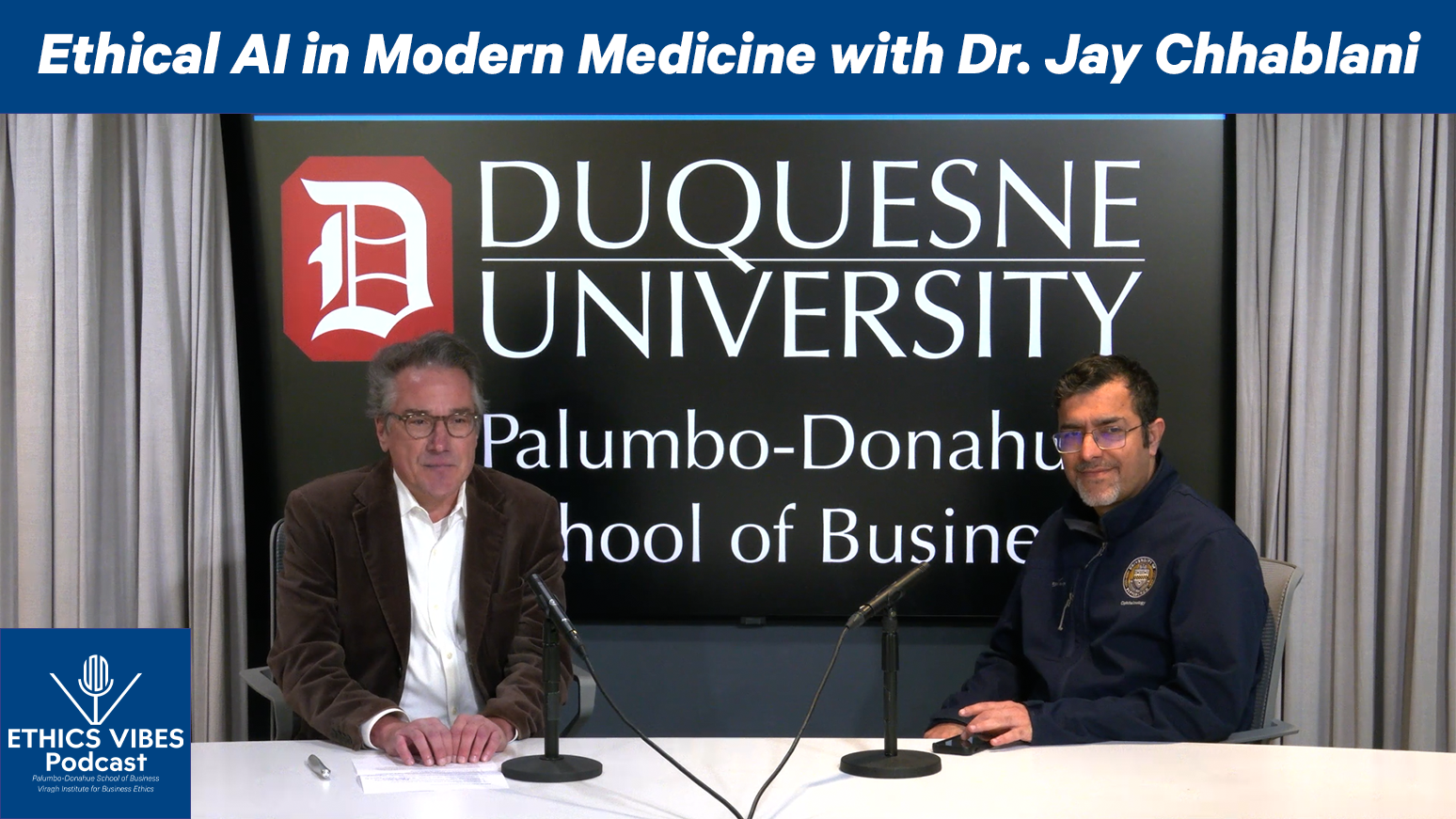
Ethical AI in Modern Medicine - Netramind Innovations
Scaling with Purpose - Wright Childcare Solutions
Beyond the Bottom Line - Holy Family Institute
Comfort Meets Conscience - Hugh & Honey

Microalgae, Big Impact - AlgenAir
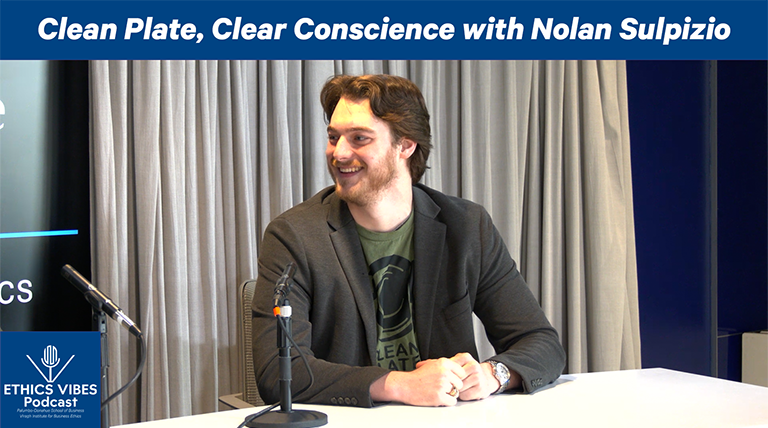
Clean Plate, Clear Conscience - Clean Plate Innovations
In 2017, VIBE launched an annual book series, entitled Business and Society 360, with the support of the Beard Faculty Resource Fund in Business Ethics. Business and Society 360 Book Series, published by Emerald and sponsored by the International Association for Business and Society, is an annual publication featuring a comprehensive discussion and review of the current
state of the research and theoretical developments in a specific business and society
topic. A “360-degree examination” of a research area involves an all-around assessment using multiple field experts to supply an analysis and review for the
purpose of achieving a full understanding of a topic. Each volume is a combination
of invited and editorial reviewed chapters providing an overview of past work and
highlighting cutting-edge research on the selected topic. Six volumes in the series have been published thus far. They include: “Corporate Social Responsibility: Volume 2” “Sustainability: Volume 4” “Social Entrepreneurship: Volume 5” “Diversity, Equity, and Inclusion (DEI) Management: Volume 6”
Business and Society 360 Book Series
“Stakeholder Management: Volume 1”
Published: 05-23-2017, Co-Editors: Dr. David Wasieleski and Dr. James Weber
Scholars contributed to a comprehensive 360-degree evaluation of stakeholder management, encompassing cross-disciplinary research, empirical explorations, cross-cultural
studies, literature critiques, and meta-analysis projects. Volume One draws on work
in areas both inside and outside business and management.
Published: 05-14-2018, Co-Editors: Dr. David Wasieleski and Dr. James Weber
Corporate Social Responsibility formally emerged on the academic and corporate scenes in the early 1960s, evolved
over the next few decades, and quickly became one of the foundational theories and
operational frameworks guiding academic research, corporate practice, and business
education. Volume Two features chapters written by international scholars, providing
an analysis of cutting-edge work in corporate social responsibility and the emerging
challenges facing scholars and practitioners.
“Business Ethics: Volume 3”
Published: 06-07-2019, Co-Editors: Dr. David Wasieleski and Dr. James Weber
Business Ethics, broadly defined, encompasses work in a variety of sub-disciplines of research. Leading
scholars in the field provide their insights on each area and offer their views on
the future. Volume Three includes chapters addressing business ethics research across
the individual, organizational, and institutional/systemic levels of analysis. Topics
in behavioral business ethics, ethical leadership, philosophical foundations, group
morality, corruption, moral development, technology, and neuroscience are all surveyed.
Published: 06-15-2020, Co-Editors: Dr. David Wasieleski and Dr. James Weber
Volume Four addresses cutting-edge research in the sustainability area (broadly defined) that has the potential to advance theories. Reflecting “new” original research, Volume Four highlights a combination of theoretical and empirical
pieces that offer potential for future research. Sustainable development involves
meeting the "needs of the present without compromising the ability of future generations to meet
their own needs" (Brundtland Commission Report, 1987). As a critical component of business and societal
relationships, this area encompasses social and ecological sustainability, including
sustainable supply chains, addressing the Sustainable Development Goals (United Nations),
human rights, reporting, finance, social innovations, and planetary boundaries.
Published: 11-24-2021, Co-Editors: Dr. David Wasieleski and Dr. James Weber
Volume Five addresses cutting-edge research in the social entrepreneurship area (broadly defined) that has the potential to advance the theories. Social entrepreneurship
is a subfield of business and society that has gained increasing influence in the
Academy. This growing area of scholarship involves addressing social, cultural, and
environmental issues through innovative and entrepreneurial ventures, including the
creation of ideas, their funding, and implementation. Social entrepreneurship focuses
on positive social change through the identification of venture opportunities and
the realization of entrepreneurial principles and processes.
Published: 08-13-2024, Co-Editors: Dr. David Wasieleski and Dr. James Weber
Volume Six addresses cutting-edge research in the Diversity, Equity, and Inclusion area (broadly defined) that has the potential to advance theories. Volume 6 provides
a comprehensive, multidisciplinary overview of DEI in organizational contexts, exploring
the historical roots, emerging trends, and future directions of DEI research and practice.
It covers topics such as women’s inequality in the workplace, intersectional stereotypes,
language-based stigma, and institutional frameworks for equitable inclusion. Drawing
on perspectives from psychology, sociology, business ethics, and management theory,
the book offers both theoretical depth and practical insights for scholars, practitioners,
and managers seeking to integrate DEI into their organizational strategies.
Volume 7: Ethics and AI in the New Digital Revolution
In Process
Ethics and AI in the New Digital Revolution presents cutting-edge research in the area of technology, business, and society.
As technology advances, it has a profound influence on business organizations and
societal dynamics. Volume 7 advances theoretical understanding and practical cases
within this evolving domain. The chapters explore how emerging technologies can drive
innovation, transform industries and everyday life, and tackle global challenges.
It also examines how individuals, organizations, and societies can adapt to rapid
technological change and respond to unforeseen ethical and structural implications.
With a strong emphasis on interdisciplinary inquiry, the volume integrates perspectives
from tech ethics, AI, and social cybersecurity.
Business and Society Review (BASR) is a leading peer-reviewed journal in the field of business ethics, publishing original
theoretical and empirical research that examines the complex relationships among business,
society, the environment, and the public good. Since January 2020, the editorial home of BASR has been housed within VIBE at Duquesne
University’s Palumbo-Donahue School of Business. This milestone reflects the School’s
leadership in advancing ethical business scholarship. Dr. David Wasieleski, the Albert Paul Viragh Professor in Business Ethics, serves
as editor-in-chief. Jason Pattit from the University of St. Thomas in Minnesota serves
as managing editor. VIBE’s stewardship of the journal underscores the School’s commitment
to shaping critical discourse in the business and society domain. Founded in 1972, Business and Society Review is published by Wiley.
Since taking over the editorship of the journal 5 years ago, we are gratified
by the progress and notoriety BASR has achieved. Our submissions and subscriptions
are rising due to our increased impact factor and inclusion on the major ranking lists.
Our goal is to continue to improve the reputation of BASR to become one of the leading
journals in our field.”
Business and Society Review Journal Editorship

Deloitte Technology Ethics Curricular Framework
VIBE served as the lead institution in developing a Technology Ethics Curriculum Framework in collaboration with the University of Notre Dame, University of Virginia, and the University of Arkansas. Funded by the Deloitte Foundation, the framework seeks to prepare students for understanding issues associated with the intersection of technology and ethics and to assist business schools and other educational settings in curriculum development and program planning.
About the Framework
Developed during a 2021 virtual Tech Ethics Summit, the framework is the result of a collaboration between 30 academics and practitioners focused on transforming tech ethics education for business students. The framework generated from a series of thought questions discussed at the Summit including normative tools, technology issues, design and integration, and delivery.
The resulting framework is designed to assist faculty as they teach students to:
- Analyze and discuss the intersection of technology and ethics
- Support informed, ethical decision-making
- Develop competencies for responsible action in tech-driven environments
Key features of the curriculum framework include:
- Student competencies
- Core ethical principles
- Ethical pedagogical frameworks
- Sample course materials, and assessment techniques
Within the framework, ten primary areas of study are presented, ranging from value-laden biases in technology, to the purpose of the firm and goals of technology, to whistleblowing. Depending on the learning objectives, the curriculum framework could incorporate a single module on tech ethics into an existing course or serve as the foundation for building a large degree program.
Albert P. Viragh Institute for Business Ethics Visiting Scholars Program
VIBE offers a Visiting Scholars Program to a limited number of highly qualified faculty and advanced doctoral students. The purpose of the VIBE Visiting Scholars Program is to bring scholars in the business and society, business ethics, or sustainability fields to Duquesne University in order to further their own research and promote the research agenda of the Institute. The Program offers opportunities for scholars to collaborate with Duquesne business school faculty members on shared scholarly and research-related interests. It also helps to create an international network for scholars at any stage of their career, assisting them in their professional development. Finally, the Program demonstrates the active role the VIBE plays in generating innovative research through participating scholars from diverse disciplinary, institutional, and geographic backgrounds. The inaugural Visiting Scholars, Florencio Portocarrero and Nuno Guimaraes Da Costa, arrived in the academic year, 2022-2023.
2025-2026 Visiting Scholar

Dr. Alejo G. José Sison
Welcome, Dr. Alejo José G. Sison, from the University of Navarro, as our International Visiting Scholar for the 2025-2026 academic year. Dr. Sison’s research explores how virtue ethics can provide a distinctive response to issues concerning the engagement with Artificial Intelligence (AI), including privacy, transparency, distributive justice, the transformation of work, the need for connection, knowledge production, and the possibility of Artificial General Intelligence (AGI).