Our Master's Science in Education in Applied Behavior Analysis (ABA) is a 39-credit-hour online
program designed to equip you with the necessary skills and knowledge to work effectively
with individuals with diverse academic and behavioral needs. As a graduate of this
program, you will be qualified for employment in school, community or clinical settings.
You may also apply for the Licensed Behavior Specialist (LBS) offered by the Pennsylvania
Board of Medicine. Our curriculum is designed to meet the BACB Pathway 2 coursework
requirements toward eligibility to sit for the Board Certified Behavior Analyst (BCBA®)
Examination. Learn more about board certification.
The ABA program at Duquesne is committed to teaching practices rooted in compassionate
care. Compassionate care embodies ensuring students have the interpersonal skills
required to successfully implement behavior analytic techniques in a caring, thoughtful
and ethical manner. Learn more about compassionate care.
Program Information
Our M.S.Ed. in Applied Behavior Analysis (ABA) curriculum will prepare you for advancement
within various schools, communities and clinic settings. Our program provides the
coursework component for eligibility to take the BCBA® Examination. Additional requirements
including but not limited to, field supervision is required before sitting for the
BCBA® exam and not provided by our program. Our coursework meets the criteria to apply
for the Licensed Behavior Specialist (LBS) certification offered by the Pennsylvania
Board of Medicine however, the coursework may not meet all of the requirements for
the certificate.
Our M.S.Ed. Applied Behavior Analysis (ABA) curriculum is fully online. The courses
are asynchronous, providing you the flexibility to take classes at your convenience
and complete your degree on your own schedule.
Compassionate-care-based training is incorporated into each course to prepare you
to apply this process in your work as a behavior analyst. This is an overview of compassionate
care and how it is embedded into our curriculum.
Compassion means to be aware of others' distress and to do something to alleviate
that distress. The action of compassion is a fundamental aspect of human interactions
and forms the bedrock of most caring professions.
Compassionate care in ABA is an intentional, explicit and systematic process for prioritizing
and teaching interpersonal and ethical skills to students of ABA with a behaviorally
analytic lens. Compassionate-care-based behaviors include actions that BCBA®s can
demonstrate to ensure that clients, colleagues and caregivers are treated with empathy,
dignity and respect throughout all interactions with BCBA®s.
A sample of compassionate-care-based behaviors may include:
Receiving Feedback
Giving Feedback
Advocacy
Perspective-taking
Psychological Flexibility
Cultural Awareness and Humility
Voices from the autistic* community and others who have undergone ABA treatment have
inspired some board-certified behavior analysts (BCBA®s) to actively incorporate teaching
compassionate-care-based skills to Applied Behavior Analysis (ABA) students. How we
implement interventions and our ability to build relationships and collaborate with
those we work with is paramount to the success of overall client treatment.
At Duquesne, we continue to strive for excellence in our field and provide the best
care possible to those who need it. Our ABA program systematically and intentionally
incorporates compassionate-care-based training into each course, emphasizing the importance
and role of compassion in delivering ABA treatment.
*Note: Insight into the use of identity-first language is provided by the Autistic Self Identity Network.
The ABA program at Duquesne uses various methods for teaching compassionate-care-based
skills to students throughout the program. Some of those methods include:
In-depth discussions, critical thinking and reflection opportunities on compassion-based
behaviors from a behavioral analytic lens throughout their coursework during case
study work and fieldwork
Incorporation of operational definitions for compassionate care behaviors using actionable
behaviors
The use of Behavioral Skills Training (BST) to learn and practice compassionate-care-based
behaviors
Self-management opportunities and training to practice and note progress on compassionate-care-based
skills
Opportunities to participate in and/or be part of research related to compassionate
care in ABA
The ABA program at Duquesne University believes that prioritizing and teaching the
actions of compassion through a behavioral analytic lens is foundational and essential
in developing effective, competent and ethically-minded practitioners.
Having the opportunity as a student to receive training and feedback about compassionate
care behaviors throughout your coursework will enhance your ability to work effectively
with clients, caregivers and colleagues. Such opportunities create a culture to consider,
reflect, apply and practice these skills before you become a practitioner in the field.
Developing compassionate care-based skills also has the potential to improve outcomes
for clients and collaboration and interactions with caregivers and colleagues.
The ABA program faculty at Duquesne recognizes and accepts the critiques from the
autistic community and strives to create practitioners who will work collaboratively
with clients, caregivers, and colleagues to create socially significant and meaningful
change for the individuals we serve. The implementation of a framework of compassionate
care in ABA reflects a deep commitment to teaching students to use behavioral analytic
practices that not only create effective behavioral change but, at its core, consider
the holistic nature of the human experience to best meet the needs of the various
individuals being served through this science.
BACB® Updates
Information regarding Behavior Analyst Certification Board (BACB®)
The Verified Course Sequence (VCS) system through ABAI will sunset Jan 1, 2026. As
of Jan 1, 2026, the ABA program at Duquesne University continues to meet criteria
through the Pathway 2 application process. The program has an approved pathway 2 contact.
The ABA program at Duquesne University is currently working to realign with 6th edition
requirements which will be fully in place by Jan 1, 2027.
December 31, 2026 is the last day to submit an application for the BACB’s 2022 (5th
Edition) eligibility requirements.
If you apply for BCBA® certification exams after Jan 1, 2027, you will be expected
to meet the 2027 Certification Requirements. Review BACB® changes in the BACB® March 2022 Newsletter
Be sure to frequently check the BACB® website for important continued certification announcements and newsletter updates.
Advance Your Career and Make an Impact
Information from the Bureau of Labor Statistics and Behavior Analyst Certification
Board, Inc.® (BACB®)
20%Job Growth Rate
BCBA® job growth is expected to increase by more than 20% in the next eight years
(Bureau of Labor Statistics).
1,942%Increase in demand for BCBA®s
The demand for BCBA®s increased by 1,942% from 2010 to 2018. Between 2017 and 2018,
demand increased by 127%. This increase has occurred in all 50 states (BACB®).
CareerOpportunities
Graduates have multiple career opportunities in various ABA subspecialties. The Behavior
Analyst Certification Board (BACB®) provides a summary of these options from behavior
analysis in education, health and fitness, environmental sustainability and more.
The demand for behavior analysts is increasing: Annual nationwide demand for individuals
holding BCBA® Certification has increased each year since 2010, with a 23% increase
from 2021 to 2022 (BCBA®, 2022).
Curriculum
Discover course descriptions in the University Catalog. Select this year's Graduate
Catalog and navigate to course descriptions section.
The Association for Behavior Analysis International has verified the following courses
toward the coursework requirements for eligibility to take the Board Certified Behavior
Analyst® or Board Certified Assistant Behavior Analyst® examination. Applicants will
need to meet additional requirements before they can be deemed eligible to take the
examination. This program requires a minimum of 39 credit hours. The candidate will
develop skills and competencies appropriate related to the Behavior Analyst 5th edition
task list. They will have the opportunity to join faculty research projects, or develop
their own research projects. The curriculum in this program will build a solid foundation
in applied behavior analysis (ABA) that provides necessary coursework for Licensed
Behavior Specialists (LBS) in the Commonwealth of Pennsylvania. This program does
not meet the requirements for CBP/HD Special Education teaching certification in the
Commonwealth of Pennsylvania. This program does not meet the field-based experience
requirements for the LBS.
M.S.Ed. Applied Behavior Analysis with BCBA® (5th Edition Task List/6th Edition Test
Content Outline)
GSPE 500 Orientation to Special Education (0 credits)
For admission to this graduate program in Special Education, you must meet the minimum
GPA requirement (3.0) in your previous coursework.
*Applicants are customarily expected to have a 3.0 grade point average, based on a
four-point scale, in their undergraduate work. However, exceptions may be granted
on a limited basis, in which there is substantial additional evidence of a student's
academic competency.
International Applicants
Effective January 1, 2023, initial BACB® certification applications will no longer
be accepted from individuals who reside outside of the US, United Kingdom, Canada
& Australia. FAQs About the 2023 International Changes.
Additionally, International Students seeking fully online programs are not eligible
for U.S. Student Visas. Visit International Admissions for additional information and requirements.
Rolling Admissions
Our M.S.Ed. ABA program has a rolling admissions process. This means you can apply
anytime throughout the year.
Official transcripts Official transcripts from all institutions of higher learning attended, sent directly
from the institution. We are unable to accept transcripts sent directly from applicants.
Personal Statement
Prompt: Describe any previous academic, professional or volunteer experiences that have prepared
you for this program and the field of ABA. How have these experiences shaped your
understanding and interest in applied behavior analysis?
CV/resume
Financing Your Graduate Education
A Duquesne University education is an investment in your future. This investment will
prepare you to reach the height of your career and provide a meaningful return on
your investment. Financial assistance in the form of aid, assistantships, scholarships
and tuition awards are available to help you reach your bigger goals.
Early Start Program - Applied Behavior Analysis (ABA), M.S.Ed.
Undergraduate students across the University can start graduate studies in the M.S.Ed.
Applied Behavior Analysis (ABA) program. During your undergraduate studies, you have
the opportunity to take up to five courses in this master's-level program at the undergraduate
tuition rate.
We welcome you to connect with us to learn more. We will guide you through the application
process.
If you are a Duquesne student inside the School of Education, reach out to your student
success coach.
If you are a Duquesne student outside of the School of Education, please contact our program to explore this opportunity.
Student Perspective
Learning how to implement compassionate care throughout my coursework has been
indispensable to my career. It has greatly improved the level of rapport I am able
to establish with clients as well as the quality of services I provide.
Katelyn NiggemyerM.S.Ed. ABA '25
Making an Impact with ABA
Autism Family Advocacy - Community Partnerships
Dr. Reva Mathieu was awarded the Charles Henry Leach II Fund for Duquesne University.
This grant brings together School of Education graduate students, university faculty
and clinicians at Keystone ABA in Pittsburgh to co-deliver a family advocacy training
program for families of young children with autism, grounded in a compassionate care
approach that centers respect, trust and empathy in every interaction.
Collaboration, Compassionate Care and a Dissertation that Makes a Difference
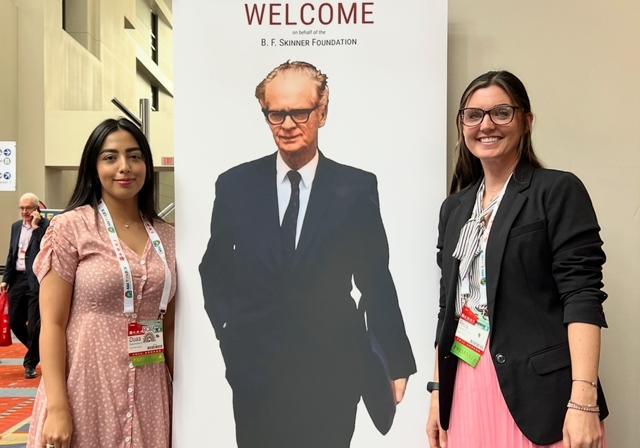
Duaa Alzahrani, GE'26, shares, "I wanted to get to know autism more and learn how
to help. My passion for it grew when I learned about ABA..." Duaa reflects on Dr.
Reva Mathieu's support for her dissertation, “I didn't have many resources to support
the hypothesis I had for my dissertation, but she (Dr. Mathieu) was willing to take
on that challenge..." Dr. Mathieu said, ‘we can figure this out; I see your vision.’"
Duaa explains, "My dissertation is implementing ABA procedure, but it's not done traditionally...It's
done within a person-centered, compassionate care model with a multi-level framework:
institutional level, practitioner level and treatment level.”
Impacting Teacher Preparation & PreK-4 Students
Dr. Reva Mathieu (ABA & BCBA®) & Dr. Kara McGoey (Child & School Psychology) were
awarded the Charles Henry Leach II Fund for Duquesne University for their project,
"Supporting At-Risk, Marginalized Preschool Children by Training Teachers on Self
and Co-Regulation Strategies." Their work will help our graduate students make an
impact in the PreK-4 classroom.
Demonstrate and apply Compassionate and Person-Centered Care within Behaviorally-Analytic
Approaches.
Develop proficiency in Behavioral Assessment Skills.
Develop proficiency in designing behavioral, academic, and social/emotional interventions
within an ABA Scope of Practice.
Demonstrate and apply ethical decision-making practices within ABA Professional Practice.
Develop iterative skills related to Cultural Responsiveness and Inclusive Practices.
Demonstrate ABA Research and Analytical Skills Connecting Theory to Applied Practice.
Our Mission
Since its inception in 1964, the philosophy of Duquesne University's Special Education
program has been one that acknowledges the dignity and uniqueness of each individual.
Our mission is to prepare skilled educators who will maximize the potential for achieving
a meaningful quality of life for individuals with disabilities.
It's Time for Bigger Goals
Our Scholarships & Awards
Explore our scholarships and awards to help fund your degree and achieve your bigger
goals.